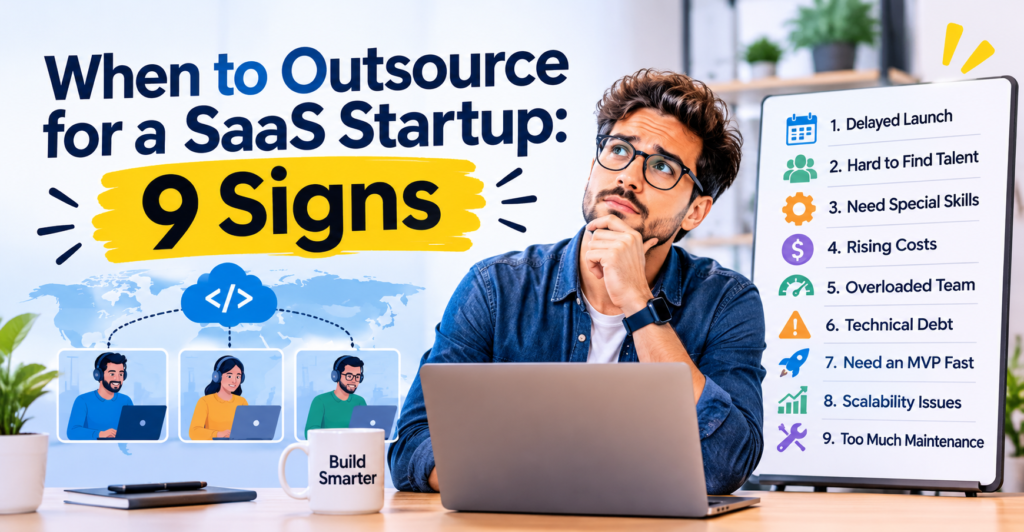
Knowing when to outsource for SaaS startup can make a major difference in development costs, product quality, and launch speed. Outsourcing makes sense when your business needs technical skills, extra development capacity, or faster delivery without the expense of building a full in-house team. The key is knowing which tasks to outsource, when to hire external experts, and which business decisions should remain under your control.
- 📌 What Does SaaS Development Outsourcing Mean?
- 🚀 9 Signs Your SaaS Startup Should Outsource Development
- ⚠️ When Should a SaaS Startup Avoid Outsourcing?
- 📈 When to Outsource at Different SaaS Startup Stages
- 🛠️ What Should SaaS Startups Outsource First?
- 🏢 What Should SaaS Startups Keep In-House?
- ⚖️ In-House vs. Outsourced vs. Hybrid SaaS Development
- 💰 How Much Does SaaS Development Outsourcing Cost?
- 🔍 How to Choose the Right SaaS Development Outsourcing Partner
- 🔐 How to Outsource SaaS Development Without Losing Control
- 🗓️ A Practical 30-Day SaaS Outsourcing Action Plan
- ❓ Frequently Asked Questions
📌 What Does SaaS Development Outsourcing Mean?
SaaS development outsourcing means hiring an external software development company or team to build, maintain, or improve your Software as a Service product. Instead of recruiting every developer internally, a startup gets access to skilled professionals when needed.
An outsourced team can support different stages of the SaaS product development lifecycle, including planning, UI/UX design, coding, testing, deployment, and maintenance.
This approach can reduce hiring delays and help startups reach the market faster. For example, a founder with a validated product idea can hire an external team to build an MVP while focusing on customer research and business development.
🚀 9 Signs Your SaaS Startup Should Outsource Development
1. Your Product Launch Is Consistently Delayed
If development deadlines keep moving because your team lacks enough developers, outsourcing may help. An external team can add resources and handle specific development tasks without waiting for lengthy recruitment processes.
2. You Cannot Find the Right In-House Developers
Finding experienced developers can be expensive and time-consuming, especially for early-stage startups. An outsourced development team gives you access to professionals with different technical skills without hiring every specialist permanently.
3. Your Startup Needs Specialized Technical Expertise
Some SaaS products require skills in cloud computing, cybersecurity, AI integration, API development, or database architecture. Hiring specialists for short-term needs may not be practical.
Outsourcing allows startups to access this expertise when required instead of maintaining a large technical department.
4. Development Costs Are Exceeding Your Budget
Building an in-house team involves salaries, recruitment fees, employee benefits, software licenses, and training expenses. These costs can put pressure on a startup’s limited funding.
Outsourcing can provide more flexible spending because you can choose the project scope and team size based on your budget.
5. Your Existing Team Is Overloaded
Your internal developers may already be responsible for product improvements, bug fixes, and customer requests. Adding new development projects can reduce productivity and increase delays.
An external team can manage separate tasks while your core employees focus on business-critical work.
6. Technical Debt Is Slowing Down Development
Technical debt develops when developers use quick solutions that create problems later. Poor documentation, outdated code, and weak architecture can make new features harder to build.
Experienced external developers can review existing systems, improve code quality, and recommend better technical practices. However, give them access to clear documentation and internal technical guidance.
7. You Need to Build an MVP Faster
A Minimum Viable Product (MVP) helps you test a business idea using only its most important features. Outsourcing can help you design, develop, and test that product without building a complete internal team.
For example, a startup creating project management software could outsource login systems, dashboards, and basic integrations while its founder tests the product with potential customers.
8. Your SaaS Product Needs Better Scalability
As users increase, your software may face performance problems, database limitations, or infrastructure issues. These challenges often require advanced technical knowledge.
An outsourcing partner with SaaS experience can help improve cloud infrastructure, database performance, security, and system architecture.
9. Maintenance and Support Are Taking Too Much Time
Launching a SaaS product is only the beginning. Regular updates, bug fixes, security patches, and performance monitoring are necessary to keep it reliable.
Outsourcing maintenance and support can free your internal team to focus on new features, customer relationships, and business growth.
⚠️ When Should a SaaS Startup Avoid Outsourcing?
Outsourcing is not the right choice for every startup. Sometimes, hiring external developers too early can increase costs without solving the real business problem.
Avoid outsourcing when:
- Your product requirements are unclear: Developers cannot deliver the right solution if you have not defined the problem, target audience, or essential features.
- Your idea is not market-validated: Test customer demand before investing heavily in development.
- Nobody can manage the external team: You need someone internally who can review progress, approve deliverables, and make technical decisions.
A startup does not always need a technical co-founder, but it does need someone capable of managing product requirements and technical quality.
📈 When to Outsource at Different SaaS Startup Stages
Your outsourcing needs change as your company develops. Choosing the right time can prevent unnecessary spending.
Idea Validation and Pre-Seed Stage
At this stage, focus on customer interviews, market research, and product validation. You can outsource prototype design or a small technical proof of concept instead of building a complete application.
MVP Development and Product Launch
This is often a suitable stage for outsourcing. A dedicated development team can build essential features, test the application, and prepare it for launch.
Early Traction and Product-Market Fit
Once customers start using your product, outsource specialized work such as QA testing, API integrations, and performance improvements. Keep customer feedback and product decisions close to your internal team.
Scaling and Business Expansion
Growing SaaS businesses may need advanced cloud infrastructure, cybersecurity, DevOps, and ongoing maintenance. Outsourcing these functions can support growth without requiring immediate expansion of every internal department.
🛠️ What Should SaaS Startups Outsource First?
Start with tasks that require specialized skills or additional development capacity.
UI/UX Design and Frontend Development
External designers can create user-friendly interfaces, wireframes, and prototypes. Frontend developers can turn approved designs into responsive application screens.
Backend Development and API Integrations
Outsource database development, authentication systems, server-side logic, and third-party API integrations when your internal team lacks the required expertise.
Quality Assurance and Software Testing
Independent QA specialists can identify bugs, test different devices, and check application performance before release.
DevOps, Cloud Infrastructure, and Technical Documentation
Cloud experts can configure deployment pipelines, monitoring systems, backups, and infrastructure. Technical writers can also document APIs, architecture, and development processes.
🏢 What Should SaaS Startups Keep In-House?
Some responsibilities should remain under direct company control because they shape the product’s long-term direction.
Keep these activities in-house:
- Product strategy: Decide what to build, which customers to serve, and which problems to solve.
- Customer discovery: Maintain direct communication with users and understand their needs.
- Core business logic: Protect the features and processes that give your product a competitive advantage.
- Technical direction: Maintain internal oversight of architecture, security, and major technology decisions.
You can outsource implementation while keeping ownership of important business and product decisions.
⚖️ In-House vs. Outsourced vs. Hybrid SaaS Development
The right development model depends on your budget, technical needs, and long-term plans.
| Factor | In-House Team | Outsourced Team | Hybrid Team |
|---|---|---|---|
| Initial cost | Usually high | Flexible | Moderate |
| Hiring time | Often longer | Usually shorter | Moderate |
| Control | Direct | Contract-dependent | Shared |
| Technical expertise | Depends on hires | Access to specialists | Combined expertise |
| Flexibility | Depends on team size | High | High |
| Long-term scalability | Requires recruitment | Depends on partner | Balanced |
In-house development works well when you need continuous control over core technology. Outsourcing suits startups that need external skills or temporary development capacity. A hybrid model combines internal product ownership with external technical support.
For many growing SaaS businesses, the hybrid approach offers a practical balance.
💰 How Much Does SaaS Development Outsourcing Cost?
The cost depends on project complexity, developer experience, location, team size, and delivery requirements. A simple MVP will generally require fewer resources than a complex SaaS platform with advanced integrations and security needs.
Outsourcing an MVP Development Project
MVP pricing depends on the number of features, design requirements, backend complexity, and testing needs. Define essential features before requesting quotes so vendors estimate the same scope.
Hiring a Dedicated Development Team
A dedicated team usually works on your product over an agreed period. Costs depend on the number of developers, their experience, and the required project management and QA support.
Staff Augmentation vs. Full-Service Outsourcing
Staff augmentation adds external developers to your existing team. Full-service outsourcing gives a provider responsibility for delivering an agreed project or solution.
Compare the complete costs, not just hourly rates.
To calculate outsourcing ROI, consider:
Outsourcing ROI = (Financial Benefits − Total Outsourcing Costs) ÷ Total Outsourcing Costs × 100
Include recruitment savings, onboarding expenses, development costs, maintenance, time saved, and the value of launching earlier. Do not assume faster delivery automatically means higher revenue; measure actual business results.
🔍 How to Choose the Right SaaS Development Outsourcing Partner
Selecting the right provider is just as important as deciding to outsource.
Compare Different Outsourcing Models
Choose a model that matches your project requirements:
- Project-based outsourcing: Best for clearly defined deliverables.
- Staff augmentation: Useful when your existing team needs additional developers.
- Dedicated development team: Suitable for ongoing product development.
- Managed development services: Helpful when you want an external provider to manage specific technical operations.
Evaluate Technical Expertise and SaaS Experience
Review the provider’s previous SaaS projects and ask about experience with multi-tenant architecture, cloud infrastructure, API integrations, databases, security, and scalability.
Request relevant case studies, client references, and examples of similar products. A polished portfolio alone does not prove technical quality.
Watch for Common Outsourcing Red Flags
Be careful if a provider:
- Promises unrealistic delivery times or guaranteed results.
- Cannot explain its development process.
- Provides unclear contracts or unexpected charges.
- Has weak communication or refuses to share references.
- Avoids discussing code quality, testing, and ownership.
🔐 How to Outsource SaaS Development Without Losing Control
A successful outsourcing relationship requires clear responsibilities and strong project controls.
Protect Intellectual Property and Source Code Ownership
Use an NDA and a written IP assignment agreement that clearly explains ownership of custom code, designs, documentation, and deliverables.
Keep the source code in a company-controlled repository and manage developer access carefully. Never assume payment alone automatically settles every ownership question.
Establish Clear Communication and Agile Development Processes
Use an Agile development methodology with short development cycles, regular sprint planning, and weekly demonstrations.
Set clear deadlines, reporting schedules, and acceptance criteria. Tools such as Jira, Trello, or similar project management platforms can help track progress.
Plan Knowledge Transfer and Avoid Vendor Dependency
Require updated technical documentation, architecture diagrams, API details, deployment instructions, and code reviews.
Make sure your company can access the code, credentials, and project records if the outsourcing relationship ends.
Address Security and Compliance Requirements
Use role-based access, secure authentication, encrypted data transfers, and regular security testing. If your SaaS handles personal information, understand applicable GDPR requirements.
For enterprise customers, review relevant SOC 2 expectations and build appropriate security controls into development from the beginning.
🗓️ A Practical 30-Day SaaS Outsourcing Action Plan
Follow this four-week plan to start outsourcing with clear expectations.
| Timeline | Key Activities |
|---|---|
| Week 1 | Define requirements, budget, essential features, and deliverables. |
| Week 2 | Shortlist providers, review portfolios, and conduct interviews. |
| Week 3 | Run a small pilot project and evaluate technical quality and communication. |
| Week 4 | Finalize contracts, establish workflows, and begin development. |
Start with a manageable project rather than handing over your entire product immediately. A small pilot helps you assess the provider’s reliability before making a larger commitment.
❓ Frequently Asked Questions
What Is Replacing SaaS?
SaaS is not being replaced by one single technology. AI-powered applications, vertical SaaS, and agent-based software are changing how SaaS products are built and delivered, but subscription-based cloud software remains an important business model.
When Should I Outsource?
You should outsource when your startup lacks the technical skills, development capacity, or resources needed to complete important work efficiently. It is especially useful when you need specialized expertise or want to build an MVP without hiring a full internal team.
Will Outsourcing Be Replaced by AI?
AI can automate coding, testing, documentation, and other development tasks, but it does not remove the need for technical planning, security, architecture, and human oversight. Outsourcing providers are more likely to adopt AI to improve productivity than disappear completely.
What Is a Good Growth Rate for a SaaS Company?
A good growth rate depends on company size, funding, market conditions, and business maturity. Early-stage SaaS companies often aim for faster growth than established businesses, so evaluate growth alongside customer retention, recurring revenue, and profitability.
What Is the Rule of 40 for a SaaS Company?
The Rule of 40 is a common SaaS performance benchmark. It combines annual revenue growth and profit margin, with a combined result of 40% or higher often considered a healthy balance between growth and profitability.
For example, a company growing revenue by 30% annually with a 10% profit margin reaches the Rule of 40 benchmark.
What Is the 3 3 2 2 2 Rule of SaaS?
The 3 3 2 2 2 rule is an informal SaaS growth framework often used to describe a pattern of rapid business expansion. It generally refers to growth targets of 3x, 3x, 2x, 2x, and 2x across successive periods. It is not a universal industry standard, and the exact interpretation can vary.
Choosing when to outsource for a SaaS startup comes down to understanding your business needs. Outsource work when external expertise can solve a real problem, reduce delays, or improve development capacity. Keep product strategy and core business decisions under internal control, and build a working relationship that allows your startup to grow without becoming dependent on a single vendor.