
Choosing the right software for independent consultants turns a fragmented solo practice into an automated, highly profitable advisory firm. Instead of wasting 15+ hours a week on manual scheduling, chasing overdue invoices, and formatting proposals, modern tools automate your backend operations completely. To maximize profitability, solo consultants need a technology stack evaluated on ease of setup, total cost of ownership, automated workflows, and a frictionless client experience.
- The Independent Consultant's Dilemma: All-in-One Platforms vs. Best-of-Breed Modular Stacks
- Streamlining Sales, Lead Generation & CRM for Solo Consultants
- Zero-Touch Onboarding & Legal Protection: Contracts, NDAs & Client Portals
- Billing Infrastructure: Retainers, Time Tracking & Rate Cards
- Financial Operations: Cloud Accounting, Taxes & Solopreneur Expense Tracking
- Asynchronous Communication & Calendar Management
- AI Tool Integration: Replacing the Administrative Assistant
- Frequently Asked Questions
The Independent Consultant’s Dilemma: All-in-One Platforms vs. Best-of-Breed Modular Stacks
Independent consultants face a critical architectural decision when setting up their business infrastructure: consolidate into an all-in-one platform or build a customized modular stack.
All-in-One Professional Services Automation (PSA) Platforms
- Core Focus: Running your entire solo practice inside unified ecosystems like Paperbell, Bonsai, or Plutio.
- Key Benefits: Eliminates data silos entirely, provides unified client portals, allows same-day setup, and maintains single-subscription simplicity.
- Trade-offs: Offers less granular customization or advanced reporting compared to specialized enterprise point solutions.
Building a Custom Modular Tech Stack
- Core Focus: Connecting specialized point-solution tools via tech stack integration and API webhooks (e.g., Zapier or Make).
- Key Benefits: Delivers best-in-class depth for every business function (e.g., pairing HubSpot CRM + Toggl Track + Xero).
- Trade-offs: Results in a higher total cost of ownership, software subscription fatigue, and ongoing maintenance overhead across 5+ disparate platforms.
Practical EEAT Tip: If you manage fewer than 5 active client accounts at a time, start with an all-in-one tool like Paperbell or Bonsai. Only migrate to a modular stack once your monthly revenue justifies the integration maintenance and software subscription costs.
Streamlining Sales, Lead Generation & CRM for Solo Consultants
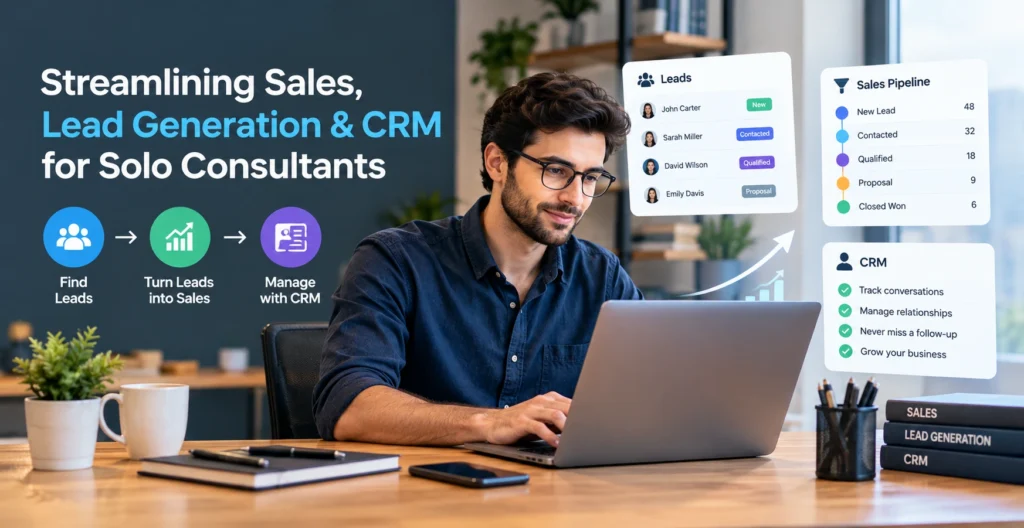
Winning high-ticket consulting engagements requires systematic deal tracking and fast, actionable proposal delivery.
CRM for Solo Consultants & Pipeline Management
- Tracks prospective clients, interaction histories, and sales stages without burdensome administrative work.
- Maintains a visible deal pipeline so future business development never stalls while delivering active client work.
- Recommended Tools: HubSpot CRM (generous free tier), Notion CRM templates, and Pipedrive.
Proposal Software & Engagement Analytics
- Generates interactive, branded proposals with dynamic pricing tiers and integrated legally binding e-signatures.
- Leverages proposal engagement analytics to notify you the exact second a lead opens a Statement of Work (SOW) or reviews pricing.
- Recommended Tools: PandaDoc, Proposify, and BidSketch.
Zero-Touch Onboarding & Legal Protection: Contracts, NDAs & Client Portals
Automating your client onboarding protects your practice legally while creating an immediate executive level of professionalism.
Document & Legal Infrastructure Automation
- Standardizes essential legal documents, including Non-Disclosure Agreements (NDAs), custom service agreements, and Statements of Work (SOW).
- Triggers e-signature requests automatically upon proposal acceptance, eliminating back-and-forth document emailing.
Automated Client Onboarding Workflows & Branded Client Portals
- The Zero-Touch Onboarding Chain:$$\text{Contract Signed} \longrightarrow \text{Deposit Paid} \longrightarrow \text{Kickoff Booked} \longrightarrow \text{Portal Provisioned}$$
- Delivers access to a secure, custom-branded client portal housing all project deliverables, updates, and shared assets in one place.
Billing Infrastructure: Retainers, Time Tracking & Rate Cards
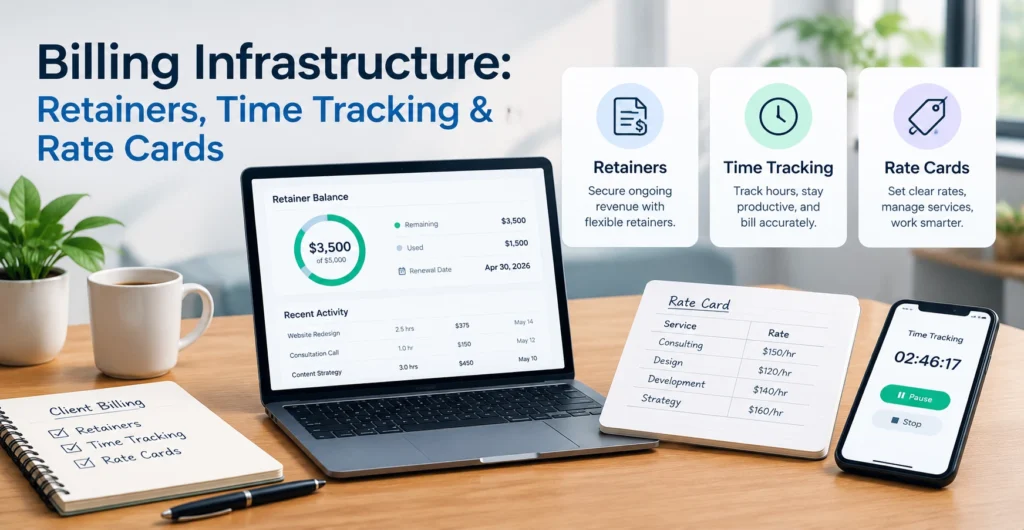
Unclear billing structures and unmonitored non-billable hours quietly drain solo consulting profits.
Hourly Time Tracking & Rate Card Optimization
- Tracks billable vs. non-billable hours to analyze true client project profitability and protect against scope creep.
- Accounts for internal administrative time (marketing, invoicing, sales) to establish accurate internal rate cards.
- Recommended Tools: Toggl Track, Harvest, and Clockify.
Retainer Management & Scope-Based Milestone Billing
- Secures recurring revenue by setting up recurring credit card auto-charges for monthly retainer clients.
- Automates milestone-based invoicing linked directly to project completion triggers to maintain steady positive cash flow.
Financial Operations: Cloud Accounting, Taxes & Solopreneur Expense Tracking
Keeping business finances organized guarantees tax compliance and provides real-time visibility into net profit margins.
Cloud Accounting & Automated Invoice Generation
- Converts logged project timesheets and completed milestones directly into professional invoices with zero manual data entry.
- Recommended Tools: FreshBooks, QuickBooks Solopreneur, Xero, and Wave.
Tax, Compliance & Solopreneur Expense Management
- Captures business deductions automatically using receipt scanning, bank account sync, and automated mileage tracking.
- Connects directly with quarterly estimated tax platforms to eliminate end-of-year tax liability shocks.
Asynchronous Communication & Calendar Management
Protecting your deep-work hours requires strict scheduling rules and boundary-focused communication platforms.
Automated Scheduling & Calendar Sync
- Replaces scheduling emails with self-serve booking links featuring automated time-zone conversion and customized calendar buffers.
- Recommended Tools: Calendly, Simply Schedule Appointments, and Acuity.
Asynchronous Communication & Boundary Management
- Replaces unnecessary live status meetings with asynchronous video walkthroughs and centralized client dashboards.
- Sets clear availability boundaries using tools like Loom and Notion, preventing scope creep and constant calendar interruptions.
Real-World Implementation: Record a 3-minute Loom video walking through complex project deliverables instead of scheduling a 30-minute call. Clients appreciate reviewing updates on their own schedule, saving you hours of live meeting time every week.
AI Tool Integration: Replacing the Administrative Assistant
Artificial intelligence allows independent consultants to operate with the capacity and speed of a small agency.
       ┌────────────────────────────────────────────────────────┐
       │                   SOLO ADVISORY PRACTICE               │
       └───────────────────────────┬────────────────────────────┘
                                   │
                   ┌───────────────┴───────────────┐
                   ▼                               ▼
       ┌───────────────────────┐       ┌────────────────────────┐
       │  AI MEETING ASSISTANT │       │ AI GENERATIVE DRAFTING │
       │  • Call Transcripts   │       │ • Discovery Summaries  │
       │  • Action Items       │       │ • SOW Frameworks       │
       │  • CRM Auto-Updates   │       │ • Research Syntheses   │
       └───────────────────────┘       └────────────────────────┘
AI Meeting Notetakers & Transcript Summarizers
- Captures, transcribes, and extracts key action items automatically during client discovery and strategy calls.
- Recommended Tools: Fathom, Otter.ai, and Fireflies.ai.
AI-Assisted Proposal & Deliverable Generation
- Drafts comprehensive proposal frameworks, synthesizes research data, and creates initial document outlines in minutes.
- Allows solo consultants to focus on high-level strategic advisory work while AI handles baseline content generation.
Frequently Asked Questions
What is the best software for consultants?
The best software depends on your practice size: single-operator solo consultants thrive on all-in-one platforms like Paperbell or Bonsai. Multi-person practices and growing consultancies require dedicated professional services automation platforms like Productive or Accelo to track team capacity and margins.
What are the 7 C’s of consultancy?
The 7 C’s of consultancy represent the core pillars of effective advisory work: Clarity (defining goals), Capability (bringing expertise), Communication (setting expectations), Commitment (delivering outcomes), Creation (building solutions), Change (driving transformation), and Confidence (establishing trust).
Is consulting dying out?
No, independent consulting is growing rapidly. Organizations increasingly favor agile, highly specialized independent experts and fractional executives over high-overhead traditional consulting firms for critical strategic projects.
How do I set myself up as an independent consultant?
Follow this concise 5-step checklist:
- Establish your legal entity (e.g., LLC) and open dedicated business banking accounts.
- Define a sharp niche positioning and service offering.
- Establish your rate card and retainer pricing structures.
- Set up a baseline software stack for contract signing, scheduling, and billing.
- Launch targeted outreach and leverage your personal network for early client acquisition.
Is AI replacing consultants?
AI is replacing manual administrative labor, basic data aggregation, and entry-level research execution. However, it elevates strategic advisors who use AI tools to increase delivery speed while offering high-level judgment, context, and client relationship management.
What type of consultants are most in demand?
The highest-demand consulting categories include AI implementation specialists, cybersecurity advisors, digital transformation leaders, fractional executives (such as Fractional CFOs and CMOs), and sustainability specialists.