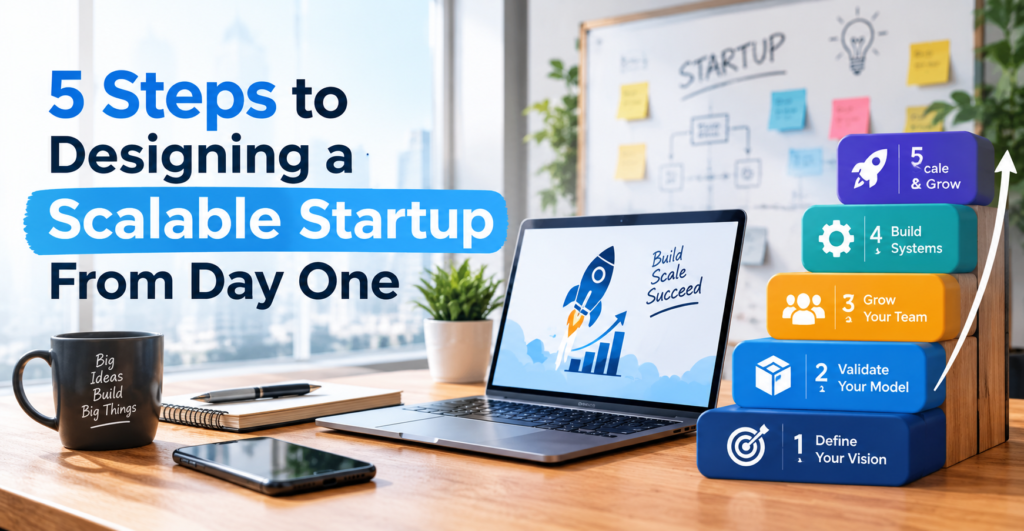
Designing a scalable startup means building a company that can grow its customers and revenue without growing its costs and problems at the same speed. You get there by planning three things early: your business model, your systems, and your team. Get those right and growth feels like momentum instead of chaos.
Many founders learn this the hard way. A product that works for 50 customers can crack at 5,000. Manual tasks pile up, costs climb faster than sales, and the team spends its days fixing problems instead of moving forward.
The good news is that scalability is mostly about small choices made early. You do not need a big budget or a perfect plan. You need to know which parts of your startup should be simple, which should be automated, and which are worth investing in now.
In this 2027 playbook, you will learn how to set up a scalable business model, choose tools and tech that grow with you, build a team that does not depend on you for everything, and avoid the common mistakes that slow young companies down.
- 🧠 Why Design-First Founders Need Branding Support
- 🎨 What Does Branding Include?
- 🔧 Systems: The Hidden Design Layer of Every Startup
- ⚙️ Exterly: The Backend System for Startup Brands
- 🧩 Exter Marketing: Design-Driven Branding for Startup Founders
- 💼 Example: From Figma to Funding-Ready in 30 Days
- 🧠 Final Thoughts: Design with Brand. Scale with Systems.
- Frequently Asked Questions
🧠 Why Design-First Founders Need Branding Support
Most design-driven or product-first founders care about user experience, interfaces, and customer flow. That’s good. But if your startup looks like every other clean, minimalist SaaS, you won’t stand out.
Your brand is the personality behind your design. It gives your product a voice, a story, and a reason to connect.
A well-crafted brand:
- Builds emotional trust with users
- Adds value to your UI through consistency
- Turns vague features into meaningful benefits
- Speeds up user adoption and loyalty
That’s why many design-led startups turn to a startup branding agency like Exter Marketing.
🎨 What Does Branding Include?
When you work with a branding agency for startups, you’re getting more than colors and logos. You’re building a brand system that supports your design system.
Here’s what that includes:
- Positioning: What space do you own in your market?
- Voice & Messaging: Clear copy across your website, onboarding, and pitch decks
- Visual Identity: Logo, typography, brand color psychology, UI consistency
- User Flow Integration: Branding that guides UX, not fights it
Startups need a brand identity that works inside their product design and their marketing layer. One that matches their user interface and elevates their backend workflows.
🔧 Systems: The Hidden Design Layer of Every Startup
If branding is the personality, systems are the operations engine.
Let’s say you’ve designed a stunning site. It’s responsive. It flows beautifully. But what happens after a visitor signs up?
Do they get a follow-up email?
Is there an onboarding sequence?
Are they added to your CRM and nurtured?
Can they book a demo?
Are reviews, payments, and referrals tracked?
If the answer is “not yet” or “I’ll automate it later,” you’re missing half the user journey.
This is where Exterly.io, our automation platform, powers up your design work.
⚙️ Exterly: The Backend System for Startup Brands
Exterly.io is a full-stack business automation tool designed for startup founders.
We built it so you don’t need 10 tools to run your backend.
You can:
- Build branded landing pages or funnels
- Set up lead forms that connect to a CRM.
- Send automated emails and WhatsApp follow-ups.
- Book appointments and manage sales pipelines
- Create onboarding workflows
- Schedule a social media post.s
- Send invoices and collect payments
- Launch online courses or digital services.
Your front-end is beautiful; now your backend can be too.
🧩 Exter Marketing: Design-Driven Branding for Startup Founders
At Exter Marketing, we specialize in helping startup founders build strong brand identities and set up their digital systems, all with a design-first mindset.
Our process includes:
- Brand discovery workshops to define mission, voice, and values
- Visual identity design with scalability in mind
- Copywriting that aligns with UX goals
- System setup inside Exterly for onboarding, engagement, and retention
- Launch assets: landing pages, pitch decks, funnels
We don’t hand you a logo and say “good luck.” We design and deploy your brand into every part of your business.
💼 Example: From Figma to Funding-Ready in 30 Days
One of our clients, a SaaS founder, had a beautiful UI but was struggling to explain their product clearly. Their site bounced traffic. Their signups didn’t convert. And post-signup engagement? Nonexistent.
We:
- Repositioned their brand story
- Redesigned their landing page
- Added automation via Exterly to handle follow-ups
- Built an onboarding funnel
- Created a brand kit to unify UI/UX and brand identity
Result? 3x lead conversion rate. A product that now looks, sounds, and functions like a polished business.
🧠 Final Thoughts: Design with Brand. Scale with Systems.
Design is not just about visuals.
Branding is not just about logos.
Systems are not just about operations.
They all work together.
If you’re designing a startup in 2025, here’s your real checklist:
- Do people get what you do in 10 seconds?
- Do they trust you based on how you present?
- Can your backend support scaling from 10 users to 1,000?
If not, now’s the time to fix it.
Frequently Asked Questions
📊 What is the 80/20 rule for startups?
The 80/20 rule, or Pareto principle, says that about 80% of your results come from 20% of your efforts. For a startup, that usually means a small share of customers, features, or channels drives most of your revenue. Find that 20% early and put your time and money there.
⚠️ Is it true that 90% of startups fail?
It is only partly true. The 90% figure roughly holds for venture-backed startups over about ten years, but broader US Bureau of Labor Statistics data shows that around 50% of all new businesses fail within five years. The number depends on how “startup” and “failure” are defined.
🚀 Can you give me an example of a scalable startup?
Airbnb is a classic example. It grew by connecting hosts and guests on a digital platform instead of buying and managing properties itself. Adding new customers costs far less than the revenue they bring in, which is the core of scalability.
📈 What business will boom in 2026?
Recent US small business data shows the fastest sales growth in office administrative services (30.0%), personal care services (28.3%), and commercial equipment wholesale (27.2%). All of them grew far faster than the 3.9% median across industries. This reflects past growth, not a guarantee, so check demand in your own market.
💡 What is the #1 reason startups fail?
The top reason is no market need, cited by 42% of founders in a CB Insights study of 101 failed startups. They built something people did not want enough to pay for. Weak branding and missing business systems also hold young companies back, as this guide on scalable startup branding and systems explains.