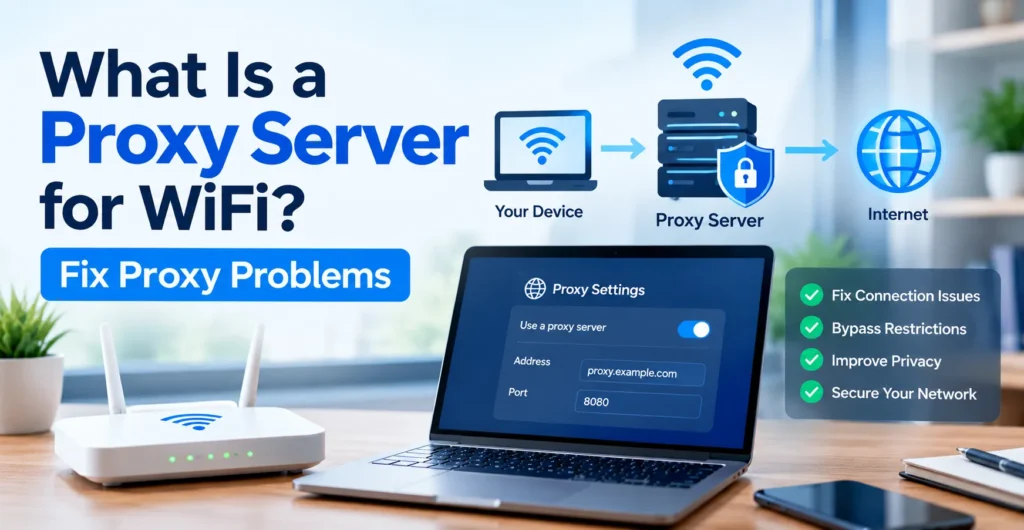
A proxy server for WiFi is an intermediary that sends supported internet requests between your device and a website. It can help change the public IP address that a website sees, manage network access, and filter web traffic. However, a proxy does not automatically encrypt all your internet activity or guarantee complete privacy.
You can configure a proxy on Android, iPhone, Windows, or macOS if you have the correct server details. The right settings depend on your device, network, and the type of proxy you use.
- What Is a Proxy Server for WiFi?
- How Does a WiFi Proxy Server Work?
- Why Do People Use a WiFi Proxy?
- What Are the Different Types of WiFi Proxy Servers?
- How to Find Your WiFi Proxy Server Address
- How to Configure a Proxy on WiFi
- How to Test or Turn Off a WiFi Proxy
- WiFi Proxy vs. VPN: What Is the Difference?
- Is a WiFi Proxy Server Safe?
- Common WiFi Proxy Connection Errors and How to Fix Them
- Frequently Asked Questions
What Is a Proxy Server for WiFi?
A WiFi proxy server is a server that receives supported requests from your device and forwards them to their destination. Instead of connecting directly to a website, your device sends the request through the proxy.
For example, an office might use a proxy to filter websites, apply access rules, or monitor network traffic. A proxy can also make a website see the proxy server’s public IP address instead of your own, depending on how the connection is configured.
A WiFi connection and a proxy are not the same thing. WiFi connects your device to a network, while proxy settings tell supported applications or network services how to route certain requests.
You do not need a proxy to use WiFi. If your network does not require one and you have no specific reason to use it, you can usually leave the proxy setting turned off.
How Does a WiFi Proxy Server Work?
When you visit a website through a proxy, your request passes through an additional server before reaching its destination. The proxy forwards the request and returns the response to your device.
Here is the process in simple terms:
- Your phone or computer connects to WiFi.
- Your device sends a supported web request to the proxy server.
- The proxy forwards the request to the website.
- The website sends its response back through the proxy to your device.
Two important details help the connection work:
- Proxy server IP address or hostname: Identifies the server your device should contact.
- Proxy port number: Identifies the network service or connection endpoint on that server.
For example, a network administrator might provide proxy.example.com as the hostname and 8080 as the port. These are illustrative values, not a working proxy configuration.
A proxy may change the IP address visible to a website, but that does not mean every app or type of traffic on your device uses it.
Why Do People Use a WiFi Proxy?
People and organizations use proxies for different reasons. The main benefits depend on the proxy service and its configuration.
- IP address changes: A website may see the proxy’s public IP address instead of your device’s usual public IP address.
- Network filtering: Schools and businesses can restrict access to certain websites or apply browsing rules.
- Caching and performance: Some proxies store copies of frequently requested content, which can reduce repeated downloads in suitable situations.
- Access management: Organizations can use proxies to control which resources users can reach.
For example, a school may require students to use a proxy to apply web-filtering rules. A company may use one to manage access to internal systems.
Proxies also have limitations. An overloaded or distant server may slow browsing, some websites may block proxy traffic, and certain apps may ignore the device’s WiFi proxy settings.
What Are the Different Types of WiFi Proxy Servers?
HTTP and HTTPS Proxy
An HTTP proxy is designed primarily for web traffic. An HTTPS connection uses encryption between your browser and the destination website, even when a proxy helps establish that connection.
HTTPS support does not mean the proxy itself automatically encrypts every connection. The protection depends on the connection method and configuration.
SOCKS5 and Transparent Proxy
A SOCKS5 proxy can handle different kinds of network traffic when the application supports it. Its flexibility makes it useful for some applications, but it does not automatically encrypt the data it carries.
A transparent proxy intercepts or redirects supported traffic without requiring the same manual configuration as a traditional proxy. It is often used by organizations and network operators for filtering or traffic management.
Proxy Auto-Configuration (PAC)
A Proxy Auto-Configuration (PAC) file contains rules that help a device decide whether a request should go through a proxy or connect directly.
Your network administrator may provide a PAC file URL. Automatic configuration is useful when different websites require different routing rules, but you should only use a trusted configuration source.
How to Find Your WiFi Proxy Server Address
If your WiFi connection already uses a proxy, you may be able to find its details in your device’s network settings.
Look for the proxy hostname or IP address, port number, and any required authentication information. If the settings are managed by your school or employer, ask the network administrator for the correct values.
If you cannot find a proxy address, your network may not use one. Your router’s IP address is not automatically the same as your proxy server address.
Never assume that a random address found online will work. Free public proxies may be unreliable or unsafe, and an address shown in a tutorial may only be an example.
How to Configure a Proxy on WiFi
Before changing settings, obtain the correct hostname, port, and any required login details from a trusted source. Menu names can vary by operating system version and device manufacturer.
Android WiFi Proxy Settings
- Open Settings and select WiFi or Network and Internet.
- Tap your connected WiFi network and open its details or edit options.
- Find Proxy, choose Manual or Automatic, enter the required details, and save.
For Manual setup, enter the hostname or IP address and port provided by your administrator or proxy provider. For Automatic setup, enter the configuration URL if requested.
iPhone Configure Proxy
On an iPhone, open Settings → WiFi → information icon beside your connected network → Configure Proxy.
You will generally see these options:
- Off: Do not use a manually configured HTTP proxy for that WiFi network.
- Manual: Enter the server address, port, and authentication details if required.
- Automatic: Use a proxy configuration URL supplied by a trusted source.
After saving, open a website to check whether the connection works. These settings apply to the selected WiFi network and do not automatically configure the same proxy for mobile data.
Windows and macOS Proxy Settings
On Windows, open Settings and look under Network & internet → Proxy. Depending on your network, you can configure a setup script or enter a proxy address and port manually.
On macOS, open System Settings → Network, select your active network connection, and look for its proxy options. The exact path may vary by macOS version.
For platform-specific guidance, consult the official Microsoft proxy settings documentation and Apple Support.
How to Test or Turn Off a WiFi Proxy
After configuration, check whether the proxy works as expected.
- Check your public IP address before enabling the proxy.
- Enable the proxy and check the public IP address again.
- Visit the website or use the app you intended to configure.
If the visible IP address changes, the proxy may be handling that request. However, this test alone does not prove that all traffic passes through the proxy or that your connection is fully private.
If your internet stops working, return to the network’s proxy settings and choose Off or the equivalent option, unless your organization requires the proxy. Reconnect to WiFi and test the connection again.
WiFi Proxy vs. VPN: What Is the Difference?
A proxy and a VPN can both change how your internet traffic reaches its destination, but they work differently. A proxy typically handles supported requests, while a VPN can route broader device traffic through an encrypted tunnel, depending on its configuration.
| Feature | Proxy server | VPN | No proxy or VPN |
|---|---|---|---|
| Traffic routing | Supported requests | Often most device traffic | Direct connection |
| IP address visibility | May show the proxy IP | Usually shows the VPN IP | Usually shows your public IP |
| Encryption | Depends on the connection and proxy type | Encrypted tunnel, depending on implementation | Depends on the destination connection |
| Common use | Filtering and request routing | Privacy and network protection | Everyday browsing |
| Setup | Proxy settings or app | VPN app or system settings | Usually no extra setup |
Choose a proxy when you need a specific routing or filtering function. Consider a reputable VPN when you need broader traffic coverage, but check its privacy policy and technical features before relying on it.
Neither option guarantees complete anonymity. Websites can still identify users through accounts, cookies, browser fingerprints, and other tracking methods.
Is a WiFi Proxy Server Safe?
A WiFi proxy can be useful, but its safety depends on who operates it and how it handles your traffic. An untrusted operator may record connection details, collect metadata, or expose unencrypted traffic.
HTTPS helps protect the content exchanged between your browser and a website. However, a proxy may still see connection metadata, such as the destination hostname in some circumstances. Never ignore browser certificate warnings or enter sensitive information through a service you do not trust.
Free public proxies deserve extra caution. Some are slow, unreliable, or operated by parties whose privacy practices are unclear. A free service is not automatically unsafe, but you should check its reputation, logging policy, and security practices before using it.
A proxy may also slow your internet because requests travel through another server. Distance, congestion, and server performance all affect speed. At school or work, follow the network administrator’s instructions instead of changing required settings or trying to bypass access controls.
Common WiFi Proxy Connection Errors and How to Fix Them
If your WiFi stops working after you enable a proxy, check these common causes.
| Problem | What to check |
|---|---|
| Incorrect server address | Confirm the hostname or IP address with the provider. |
| Wrong port number | Verify that the port matches the supplied configuration. |
| Authentication failure | Check your username and password if authentication is required. |
| Proxy server unavailable | Confirm that the service is online and your network can reach it. |
| Website or app does not work | Check whether the application supports the proxy and its protocol. |
| Settings were not saved | Reopen the network settings and verify the selected mode and entered values. |
| Internet is unusually slow | Check server distance, congestion, and whether the proxy is necessary. |
Try reconnecting to WiFi after correcting the settings. If the connection still fails, temporarily turn the proxy off if your network allows it. If the proxy is required by your employer or school, contact the administrator before making further changes.
Frequently Asked Questions
How do I find the proxy server for my Wi-Fi?
Open your connected WiFi network’s settings and look for the Proxy option. If a server address or configuration URL is already entered, you can inspect it there; otherwise, ask your network administrator or service provider because many WiFi networks do not use a proxy.
Should I have a proxy server on or off?
Leave the proxy off if your network does not require one and you have no specific reason to use it. Turn it on only when you have valid configuration details and understand what the proxy is intended to do.
Is a proxy server free?
Some proxy services are free, while others charge a fee for better reliability, support, or additional features. Before using a free service, check its privacy policy, security practices, and reputation rather than assuming it is safe.
Can you give me an example of a proxy server?
A company might provide a proxy hostname such as proxy.example.com and port 8080 to route supported web requests through its network. These are illustrative values only; you need the actual address and port from your administrator or provider to connect.
How do I find my proxy server address on my phone?
On Android, open your connected WiFi network’s details and look for Proxy under its advanced or edit settings. On an iPhone, go to Settings, tap WiFi, select the information icon beside your network, and open Configure Proxy to inspect the current configuration.
How do I set up a Wi-Fi proxy?
Connect to your WiFi network, open its proxy settings, and choose Manual or Automatic according to the instructions from your administrator or provider. Enter the required server address, port, or configuration URL, save the settings, and test the connection before relying on it.