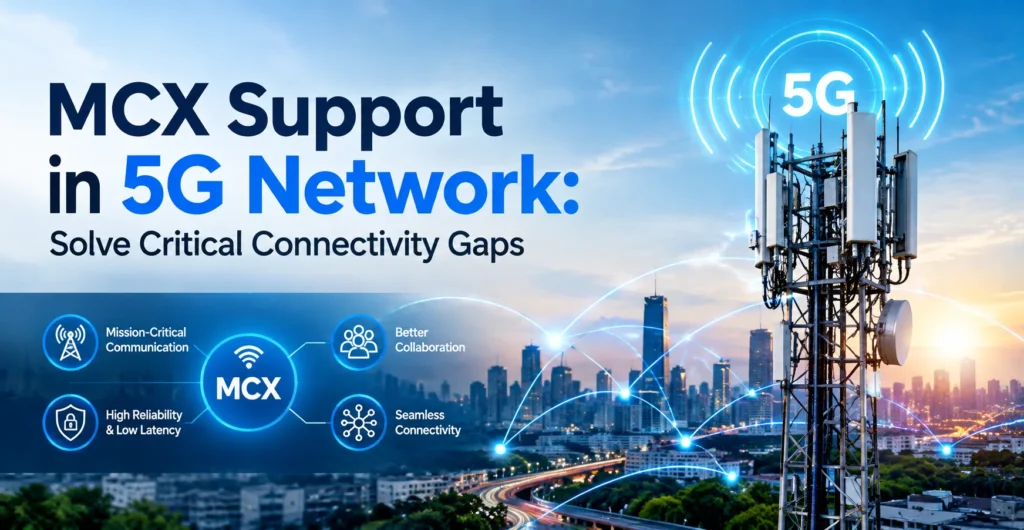
MCX support in 5G networks enables mission-critical voice, video, and data communication for teams that need reliable connectivity during emergencies and important operations. It supports services such as push-to-talk, live video sharing, and urgent alerts for public safety agencies, transport operators, utilities, and industrial teams. MCX can operate over supported 4G LTE and 5G networks, depending on the system design and available features.
- What Is MCX Support in a 5G Network?
- How Does MCX Work in a 5G Network?
- What Are the Main Types of MCX Services?
- How Do 5G QoS and Network Slicing Support MCX?
- What Are the Main Use Cases of MCX in 5G?
- MCX Over 4G LTE vs. 5G Networks
- How Does MCX Integrate With TETRA and P25 Radio Systems?
- MCX Deployment Requirements, Security, and Reliability
- Benefits and Limitations of MCX Support in 5G
- Frequently Asked Questions About MCX Support in 5G
- Conclusion
What Is MCX Support in a 5G Network?
Mission Critical Services (MCX) is a group of standardized communication services designed for situations where delayed or failed communication can put people, equipment, or operations at risk.
Unlike ordinary messaging or calling apps, MCX can support managed group calls, emergency communication, priority handling, and integration with professional radio systems. These capabilities depend on the service implementation and network configuration.
The 3rd Generation Partnership Project (3GPP) defines standards for MCX services, helping equipment and software from different vendors work together. You can explore the official 3GPP specifications for the technical standards behind mobile communications.
MCX is especially useful for police, firefighters, ambulance crews, railway operators, utility workers, and other teams that need coordinated communication.
How Does MCX Work in a 5G Network?
MCX combines mobile devices, network infrastructure, and specialized application servers to deliver communication services. A user speaks, sends video, or shares data through an MCX client, and the network carries that information to authorized recipients.
The main components work together as follows:
- User device: A compatible phone, rugged terminal, or radio gateway runs the MCX client.
- Radio Access Network (RAN): The 5G base station connects the device to the mobile network.
- 5G Core (5GC): The core network manages connectivity, subscriber access, and supported traffic policies.
- MCX application server: This manages services such as group communication, user permissions, and call control.
- Receiving devices and dispatchers: Authorized team members receive calls, messages, video, or alerts.
Key Components of MCX Architecture
MCX clients provide the interface used by field workers, while application servers manage communication sessions and groups. Dispatch consoles allow control-room staff to coordinate teams and monitor incidents.
Subscriber authentication confirms whether a user can access the service. Network connectivity, service configuration, and group membership determine how communication reaches the intended recipients.
What Are the Main Types of MCX Services?
Mission-Critical Push-to-Talk (MCPTT)
MCPTT provides push-to-talk voice communication, including group calls and emergency calling features. It allows authorized users to coordinate without placing a separate conventional phone call to each person.
For example, firefighters arriving at a building can join a designated group and share updates with their team and incident commander. Priority handling may help authorized emergency communications during congestion when the network and service support it.
Mission-Critical Video (MCVideo)
MCVideo supports mission-critical video communication, including live video sharing where the system provides the required capabilities.
An officer at an incident scene could share a live view with a control room. The remote team can use the video to assess conditions and coordinate its response, subject to available bandwidth and network coverage.
Mission-Critical Data (MCData)
MCData supports data exchange for operational communication. Examples include incident messages, status updates, alerts, and other supported information.
During a rescue operation, a team could share a location update or send an incident report. This helps team members and dispatchers work from the same information.
How Do 5G QoS and Network Slicing Support MCX?
Quality of Service (QoS) controls how network traffic is treated. Depending on network configuration, authorized mission-critical traffic may receive priority over less important traffic during congestion.
5G network slicing allows an operator to create logical network environments with different service policies and resource arrangements. A dedicated slice may help meet the needs of a public safety or industrial service when properly designed and supported.
QoS and slicing are not automatic guarantees of uninterrupted service. Results depend on radio coverage, capacity, backhaul, core network design, application performance, and the policies in place. Low latency must be measured across the full communication path, not assumed simply because a network uses 5G.
What Are the Main Use Cases of MCX in 5G?
MCX supports teams that need coordinated communication across people, vehicles, control rooms, and remote sites.
| Industry | Example use case |
|---|---|
| Public safety | Police group calls, emergency alerts, and incident video |
| Transportation | Railway operations and communication between field crews and control rooms |
| Mining | Worker safety updates and underground operational coordination |
| Utilities | Power-line repair teams and outage response |
| Manufacturing | Factory incident alerts and coordination between operators |
| Large events | Security teams managing crowds and responding to incidents |
Consider a building fire. Firefighters use MCPTT to coordinate entry, an authorized crew member shares video through MCVideo, and another sends a hazard alert through MCData. The incident commander can use these communication channels together to make better-informed decisions.
This example assumes compatible devices, configured services, and sufficient network coverage.
MCX Over 4G LTE vs. 5G Networks
MCX is not limited to 5G. Standardized mission-critical services can also operate over supported LTE networks, so organizations may not need to replace an existing system simply to adopt MCX.
| Feature | 4G LTE | 5G |
|---|---|---|
| MCX support | Supported by suitable implementations | Supported by suitable implementations |
| Network performance | Depends on LTE coverage and capacity | May offer greater capacity and lower latency in suitable deployments |
| Deployment options | Public and private LTE | Public and private 5G options, depending on availability |
| Migration needs | May reuse existing infrastructure | May require compatible devices, network changes, and testing |
A public 5G network may suit teams that operate across a wide area and can rely on operator coverage. A private 5G network may suit a factory, mine, port, or campus that needs greater control over local connectivity and network policies.
The best option depends on coverage, costs, resilience needs, spectrum rules, and the organization’s existing equipment.
How Does MCX Integrate With TETRA and P25 Radio Systems?
TETRA and Project 25 (P25) are professional radio technologies used by public safety and other organizations. Many agencies rely on these systems, so replacing them all at once may be costly or impractical.
An Interworking Function (IWF) can connect compatible MCX services with supported legacy radio systems. This allows users on different systems to communicate when the required gateways, interfaces, and configurations are in place.
Before migration, organizations should test group calls, emergency features, audio quality, and communication between different vendors. Standards compliance alone does not mean every product will work together without testing.
MCX Deployment Requirements, Security, and Reliability
Essential MCX Deployment Checklist
Before deploying MCX, organizations should check the following requirements:
- Coverage and devices: Test indoor, outdoor, rural, tunnel, and underground coverage. Confirm that devices support the selected MCX services and network.
- Network and services: Configure subscriber access, MCX servers, user groups, QoS policies, and authorized priority rules.
- Performance: Test call setup, latency, packet loss, mobility, and service behavior during busy periods.
A practical tip is to test the system at the actual worksite before full deployment. A network that performs well in an office may struggle inside a factory, mine, or concrete building.
Security and Network Resilience
Mission-critical communication may carry sensitive information, so authentication, authorization, encryption, and secure device management are important. Administrators should also control access to dispatch consoles and protect operational records.
Reliability requires more than a fast connection. Backup power, redundant network components, resilient backhaul, and alternative communication methods can help reduce service interruptions.
Multicast and evolved Multimedia Broadcast Multicast Service (eMBMS) can support one-to-many delivery in suitable architectures. Their availability depends on the network, equipment, and supported features.
MCX Interoperability Testing
Organizations should test MCX clients, application servers, network equipment, dispatch consoles, and radio gateways together. Important checks include group calls, emergency calls, priority access, handovers, video sessions, and recovery after a network failure.
The ETSI website provides standards and technical resources relevant to telecommunications and interoperability testing. Multi-vendor testing helps identify compatibility problems before a system is used in real operations.
Useful performance measures include call setup time, end-to-end latency, packet loss, audio quality, service availability, and recovery time.
Benefits and Limitations of MCX Support in 5G
MCX enables coordinated group communication, live video sharing, operational alerts, and integration with compatible communication systems. With a suitable network, it can help teams share information and respond to incidents more effectively.
However, deployment may involve high infrastructure costs, device upgrades, complex integration, staff training, and battery management. Coverage gaps and network outages can still affect service.
The key point is that 5G does not automatically guarantee mission-critical reliability. Effective MCX depends on the complete system, including devices, applications, network policies, coverage, security, and backup arrangements.
Frequently Asked Questions About MCX Support in 5G
Is 5G necessary in 2026?
No. Many everyday mobile services and supported MCX deployments can operate over 4G LTE. 5G may offer advantages in capacity, latency, and network design, but the right choice depends on the application and coverage requirements.
What are the 5G use cases?
5G supports enhanced mobile broadband, industrial automation, connected vehicles, smart infrastructure, fixed wireless access, and IoT applications. Mission-critical communication is another use case when the network and service are designed to support it.
What is mMTC in 5G?
Massive Machine-Type Communications (mMTC) is a 5G usage category designed to connect large numbers of devices, especially IoT sensors and meters that send relatively small amounts of data. It differs from MCX, which focuses on mission-critical communication services.
What is a 5G network called?
A 5G mobile network is commonly called a 5G network or 5G New Radio (5G NR) network. 5G NR refers specifically to the radio access technology, while the complete network may include a 5G Core and supporting applications.
Do Pakistan have 5G?
Pakistan’s 5G rollout and availability depend on regulatory approvals, operator deployment, location, and compatible devices. Check current announcements from the Pakistan Telecommunication Authority and your mobile operator for confirmed commercial availability in your area.
What is MCX in a 5G network?
MCX stands for Mission Critical Services. It includes standardized services for mission-critical voice, video, and data communication, with capabilities designed for teams such as emergency responders and industrial workers.
What does MCPTT stand for?
MCPTT stands for Mission-Critical Push-to-Talk. It provides push-to-talk voice communication, including group communication and supported emergency calling features.
Can MCX work on 4G LTE?
Yes. Standardized MCX services can operate over supported 4G LTE networks as well as suitable 5G deployments. Compatibility depends on the network, application servers, devices, and configured features.
How is MCX different from VoIP?
Traditional VoIP mainly provides voice calls over an IP network, while MCX supports specialized mission-critical communication features such as managed group calls, priority handling, and emergency communication. The exact difference depends on the VoIP system and MCX implementation being compared.
Can MCX connect with TETRA or P25?
Yes, MCX can interwork with TETRA or P25 systems through suitable interworking functions or gateways. Successful communication depends on compatible equipment, supported features, correct configuration, and interoperability testing.
Conclusion
MCX support in a 5G network brings mission-critical voice, video, and data services together to help teams coordinate during emergencies and demanding operations. It can work over suitable LTE or 5G networks and may integrate with legacy radio systems.
For a reliable deployment, organizations should focus on coverage, QoS, security, resilience, compatible devices, and end-to-end interoperability testing. The real value of MCX comes not simply from using 5G, but from building a communication system that works when teams need it most.