
Artificial Intelligence thrives on high-quality data, but modern AI development faces severe bottlenecks due to centralized data monopolies, high collection costs, and slow manual annotation. Alaya AI solves these issues by creating a decentralized Web3 Data Infrastructure that connects a global network of users to collect, label, and verify datasets using smart contracts, token incentives, and gamification. By merging Blockchain Technology with crowdsourced human intelligence, Alaya AI delivers scalable, privacy-preserving, and cost-effective data solutions for next-generation artificial intelligence models.
- 1. What is Alaya AI? (Decentralized AI Data Infrastructure)
- 2. How Blockchain Powers Alaya AI: Architecture & Key Features
- 3. The Dual-Token Mechanics & Ecosystem Utility (AGT & AIA)
- 4. Gamified Data Labeling & NFT Incentives System
- 5. How Alaya AI Trains AI Models (Step-by-Step Dataset Pipeline)
- 6. User Onboarding & Earn Guide: Binance Web3 Wallet Setup
- 7. Alaya AI vs. Traditional & Web3 Data Competitors
- 8. Real-World Use Cases, Industry Adoption & Project Risks
- 9. Frequently Asked Questions (FAQs)
1. What is Alaya AI? (Decentralized AI Data Infrastructure)
Overview
Alaya AI is a Web3-native Data Annotation Platform designed to power artificial intelligence through distributed global participation. Instead of relying on centralized data farms, it connects thousands of micro-annotators across the globe to train machine learning models.
Core Philosophy
Traditional AI development suffers from steep infrastructure costs, slow data turnaround times, and biased datasets controlled by tech giants. Alaya AI disrupts this model by decentralizing the dataset creation process. Through crowdsourced contributions, developers get access to accurate, diverse datasets at a fraction of traditional costs.
Web3 Integration
By leveraging a Web3 Data Infrastructure, Alaya AI coordinates task assignments, verifies quality, and executes cross-border micro-payments automatically. Smart contracts handle contributor rewards transparently, ensuring fair compensation without reliance on intermediaries.
2. How Blockchain Powers Alaya AI: Architecture & Key Features
Distributed Data Sampling
Alaya AI distributes task workloads across global user nodes. Using smart contracts, the platform assigns specific Decentralized Data Collection requests—such as image labeling, text classification, or localized audio processing—to targeted demographic groups.
Privacy-Preserving Computing & ZKPs
Protecting user privacy and proprietary data is critical when working with sensitive datasets. Alaya AI uses Zero-Knowledge Proofs (ZKPs) to verify that labeling tasks were performed accurately without exposing raw user data or compromising proprietary enterprise models.
Swarm Intelligence
To guarantee high accuracy, the platform uses Swarm Intelligence combined with Reinforcement Learning from Human Feedback (RLHF). Multiple independent nodes evaluate and verify the same data points, achieving consensus and filtering out low-quality submissions before data enters the training pipeline.
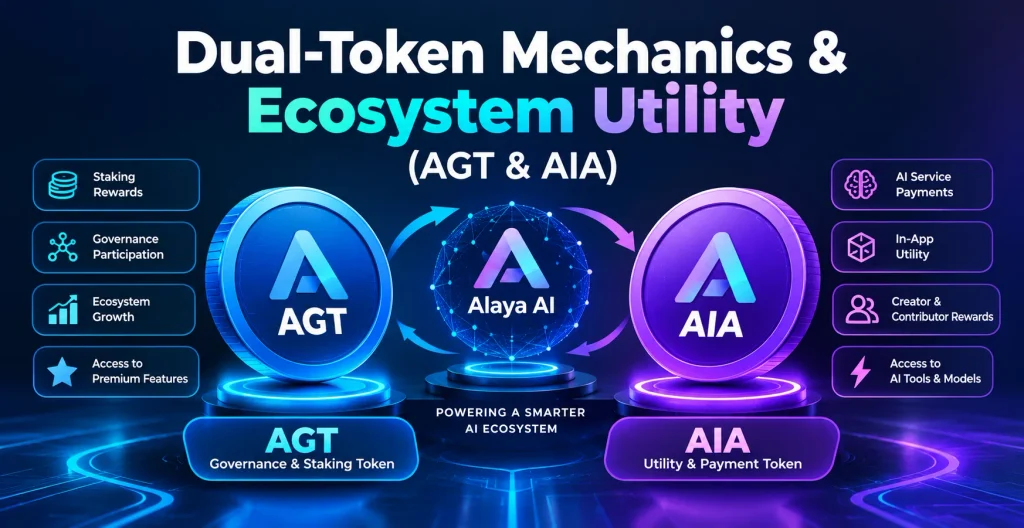
3. The Dual-Token Mechanics & Ecosystem Utility (AGT & AIA)
AGT Token Functions
The Alaya Governance Token (AGT) serves as the core utility and governance asset of the ecosystem:
- Custom Reward Pools: Developers deposit AGT to fund labeling requests.
- Staking Thresholds: Nodes stake AGT to unlock high-tier verification tasks.
- DAO Governance: Token holders vote on protocol upgrades, fee structures, and treasury allocations.
AIA Credits & Conversion
To prevent network congestion and high gas fees on routine micro-tasks, users earn AIA credits for daily data labeling achievements. AIA acts as an internal utility unit that users convert into AGT tokens upon reaching payout thresholds.
Staking & Deflationary Loop
Revenues generated from enterprise data sales fund systematic AGT token buybacks from secondary markets. Part of these tokens are burned while the remainder re-enters the ecosystem reward pool, creating a sustainable deflationary loop that balances token supply with platform growth.
4. Gamified Data Labeling & NFT Incentives System
NFT Badges/Passes
Alaya AI incorporates NFT Incentives to gamify data labeling. Users mint or earn specialized NFT Passes that determine their task access level. Upgrading these NFTs boosts daily earnings multipliers and unlocks complex, higher-paying annotation requests.
Medallion Achievement System
The platform uses non-transferable, Soulbound Medallion Badges to track individual labeling history, accuracy ratings, and domain expertise. A user with a high-reputation Medallion gets priority access to specialized dataset tasks (e.g., medical imaging or financial sentiment analysis).
Gamification UX
By transforming repetitive tagging tasks into interactive quizzes, daily streaks, and competitive leaderboard challenges, Alaya AI maintains high user retention and minimizes annotator fatigue.
5. How Alaya AI Trains AI Models (Step-by-Step Dataset Pipeline)
Step 1: Data Request & Bootstrapping
- Developers custom AGT reward pool create karte hain aur required dataset criteria specify karte hain (e.g., visual data, Social Commerce Data).
Step 2: Crowdsourced Data Collection & Tagging
- Global users mobile/web apps ke zariye sampling aur labeling requests complete karte hain automated RLHF tools use karke.
Step 3: Swarm Validation & Privacy Check
- System Zero-Knowledge Proofs (ZKPs) aur human-in-the-loop consensus ke zariye data quality check karta hai aur duplicate data clean karta hai.
Step 4: Model Injection & AI Training
- Verified, structured datasets directly Large Language Models (LLMs) aur computer vision training pipelines mein inject hotay hain.
- Data Request & Bootstrapping: Developers launch a task by locking AGT tokens and defining dataset needs (e.g., computer vision objects or localized Social Commerce Data).
- Crowdsourced Data Collection & Tagging: Global users fulfill annotation tasks through the Alaya AI app using gamified, automated tagging tools.
- Validation & Model Injection: Swarm consensus and automated validation rules filter out spam, clean duplicates, and output structured datasets directly into AI Model Training pipelines.
6. User Onboarding & Earn Guide: Binance Web3 Wallet Setup
Wallet Connection
Connecting your wallet to Alaya AI takes just a few steps:
- Open your Binance Mobile App and switch to the Binance Web3 Wallet tab (or open MetaMask).
- Navigate to the dApp browser and enter the official Alaya AI platform link.
- Tap Connect Wallet, approve the signature request, and claim your initial starter NFT pass.
Pro Tip: Keep a small amount of native gas tokens (such as BNB) in your Web3 wallet to cover minimal network transaction fees when converting AIA credits into AGT.
Airdrop & Daily Earnings
Maximize daily yield by completing routine labeling quizzes, maintaining activity streaks, participating in network swarm validation rounds, and joining ecosystem airdrop campaigns.
Referral & Booster Strategies
Invite active users via social referral links to earn a percentage of their daily AIA micro-rewards. Leveling up your primary NFT badge directly increases your daily task cap and yields higher token returns per task.
7. Alaya AI vs. Traditional & Web3 Data Competitors
| Feature | Alaya AI | Scale AI / Amazon MTurk | Generic Web3 Protocols |
| Data Verification | Swarm Consensus & ZKPs | Centralized Manual Audit | Basic Majority Voting |
| User Privacy | Privacy-Preserving (ZKPs) | Low (Data exposed to workers) | Moderate |
| Incentive Model | Dual-Token (AGT/AIA) + NFTs | Fiat Micro-payments | Single Token |
| Platform Costs | Low (Decentralized scaling) | High (Middleman fees) | Variable |
| User Engagement | Gamified Quizzes & Leveling | Tedious Manual Work | Static Task Boards |
Key Advantages
Alaya AI reduces costs for AI developers while maintaining strict privacy via Privacy-Preserving Computing. Annotators retain control over their data contributions and earn liquid crypto assets rather than low flat-rate fiat payments.
Decentralized AI Economy
By combining crowdsourced data tagging with decentralized Web3 infrastructure, Alaya AI helps establish a community-owned AI ecosystem where data contributors share directly in the value generated by modern AI products.
8. Real-World Use Cases, Industry Adoption & Project Risks
Real-World Applications
- Computer Vision: Annotation for autonomous driving obstacle recognition and drone mapping.
- Natural Language Processing (NLP): Reinforcement learning datasets for specialized localized LLMs.
- Social Commerce Analytics: Categorizing user sentiment, product trend mapping, and consumer behavior analysis.
Market Realities & Token Volatility
As with all crypto utility tokens, AGT is subject to market volatility. Investors and contributors must account for token unlock schedules, emissions rates, and overall market liquidity when participating in ecosystem staking.
Regulatory & Data Risks
Operating a decentralized data network across multiple regions requires navigating evolving global privacy regulations (such as GDPR). Alaya AI mitigates these risks through privacy-centric zero-knowledge data design, but ongoing regulatory shifts remain a consideration.
9. Frequently Asked Questions (FAQs)
Which AI coin will boom in 2026?
Projects that combine decentralized infrastructure with real-world dataset utility and sustainable tokenomics are positioned to lead as AI and Web3 converge. Tokens backed by active developer usage and revenue-driven buyback mechanics (such as AGT) offer strong ecosystem value.
What is blockchain technology in AI?
Blockchain provides an immutable, decentralized layer that handles automated data verification, tokenized user incentives, and transparent dataset provenance. It prevents data tampering and enables fair, borderless compensation for human annotators training machine learning models.
Which AI is best for blockchain?
AI platforms designed for decentralized networks—specifically those focusing on distributed data annotation, privacy-preserving zero-knowledge computing, and automated smart contract verification—are the most effective fits for blockchain integration.
Which is the best AI crypto to invest in?
Investors generally focus on utility-backed AI cryptocurrencies that have working products, active developer utilization, transparent vesting schedules, and deflationary tokenomics tied directly to enterprise platform usage.
What is the most promising crypto to buy right now?
Promising projects typically sit at the intersection of AI infrastructure, Web3 data collection, and DePIN (Decentralized Physical Infrastructure) protocols that solve real enterprise supply bottlenecks like dataset training data.
What crypto under $1 will explode?
Low-market-cap tokens in growing sectors like Web3 data labeling and gamified AI ecosystems offer room for growth. However, performance depends on user adoption rates, token unlock schedules, and broader crypto market conditions.