

Does Celsius use AI technology? There is a difference between AI being used in Celsius Holdings’ business operations and AI being used to create or formulate Celsius energy drinks. Publicly available evidence must be checked before claiming that the company uses specific AI systems, manufacturing tools, or algorithms.
AI can help beverage companies forecast demand, analyze customer preferences, and manage inventory. However, these are possible industry applications, not proof that Celsius Holdings uses each technology.
- Does Celsius Use AI Technology? The Short Answer
- What Is Celsius Holdings, and Who Owns the Company?
- What Does the Evidence Say About Celsius AI Technology?
- How AI Could Be Used in the Beverage Industry
- Does Celsius Use AI in Its Ingredients or Drink Formula?
- Potential Benefits and Risks of AI for Celsius
- How Celsius Compares With Other Beverage Brands Using AI
- What Could AI Mean for Celsius in the Future?
- Frequently Asked Questions About Celsius
Does Celsius Use AI Technology? The Short Answer
There is not enough verified evidence presented here to confirm that Celsius Holdings uses specific AI systems across its business or that AI plays a direct role in making its energy drinks.
Celsius could use AI-assisted tools for business tasks, as many companies can, but that possibility should not be treated as a confirmed fact. Likewise, there is no basis for claiming that AI is an ingredient in Celsius energy drinks.
To establish what the company actually does, readers should consult its latest annual report, official announcements, investor presentations, and public statements.
What Is Celsius Holdings, and Who Owns the Company?

Celsius Holdings, Inc. is the company behind the Celsius energy drink brand. It operates in the consumer packaged goods (CPG) industry, where companies develop, market, distribute, and sell products to consumers through retail and other sales channels.
The company is publicly traded, and its ownership includes shareholders who hold its stock. PepsiCo is also a major strategic partner and shareholder, following a distribution and investment agreement announced in 2022 and expanded in 2025.
Understanding the company matters because a claim about Celsius using AI could refer to several different activities:
- Business operations: Sales planning, marketing analysis, and inventory management.
- Manufacturing: Production monitoring, equipment maintenance, and quality checks.
- Product development: Research into ingredients, flavors, and consumer preferences.
Evidence for one activity would not automatically prove that Celsius uses AI in the others.
What Does the Evidence Say About Celsius AI Technology?
What the Celsius Holdings Annual Report Reveals
A company’s annual report is a useful starting point for checking claims about its technology and operations. Celsius Holdings’ filings with the U.S. Securities and Exchange Commission (SEC) can provide information about its business model, risks, distribution, financial performance, and operations.
When reviewing the latest available filing, search for terms such as artificial intelligence, machine learning, automation, data analytics, and predictive analytics. Then read the surrounding paragraphs to determine whether the company describes an actual implementation, a business risk, or a general industry trend.
A mention of technology alone does not confirm that Celsius has deployed AI. Similarly, if a filing does not mention AI, that does not prove that the company never uses AI tools internally.
Start with the Celsius Holdings filings on the SEC website and compare any findings with official company announcements.
Confirmed AI Use vs. Unverified Claims
Some online articles describe AI as a major part of Celsius’s marketing, product development, and supply chain operations. These statements need reliable supporting evidence before they can be presented as facts.
| Claim | Evidence needed | Reasonable conclusion |
| Celsius uses AI for marketing | Company announcement or attributable statement | Confirm only if documented |
| Celsius uses AI for demand forecasting | Official disclosure of the system or practice | Otherwise, unverified |
| AI creates Celsius flavors | Product-development evidence from the company | Do not assume |
| Celsius uses automated manufacturing | Reliable details about its production operations | Automation alone does not prove AI |
| AI is an ingredient in Celsius drinks | Verified product formulation evidence | AI is not itself a beverage ingredient |
This distinction helps readers separate verified information from speculation. It also prevents an article from repeating unsupported statistics, naming unconfirmed technology partners, or treating general industry practices as Celsius-specific facts.
How AI Could Be Used in the Beverage Industry
The following examples explain how AI works in the beverage industry. They should not be interpreted as confirmation that Celsius currently uses these systems.
Machine Learning in Beverage Manufacturing
Machine learning can help manufacturers identify patterns in production data. For example, a system could flag unusual temperature readings or detect changes in product appearance using computer vision.
Predictive maintenance systems can also analyze equipment data to estimate when a machine may need servicing. However, ordinary sensors, timers, and automated inspection equipment can perform many tasks without AI.
Predictive Demand Forecasting and Inventory Optimization
Beverage companies must estimate how much product retailers will need. AI systems can analyze historical sales, seasonal patterns, promotions, and weather data to help forecast demand.
These forecasts may help businesses plan inventory, production, and deliveries. Whether Celsius uses a particular AI forecasting system requires company-specific evidence.
AI-Driven Marketing and Consumer Behavior Analytics
AI can help brands analyze customer feedback, identify emerging trends, and compare the performance of advertising campaigns. Businesses may also use sentiment analysis to examine public reviews and social media discussions.
These tools can support marketing decisions, but they do not guarantee higher sales or accurately predict every customer’s preferences. Claims that Celsius uses a specific AI marketing platform should be supported by an official source.
Data-Driven Product Development and Flavor Research
AI can analyze product reviews, survey responses, and market trends to help researchers identify consumer preferences. In some settings, it can also suggest ingredient combinations for further testing.
However, an AI-generated flavor suggestion is not the same as an approved beverage formula. There is no basis for concluding that AI created a particular Celsius flavor without reliable evidence from the company.
Does Celsius Use AI in Its Ingredients or Drink Formula?
AI is a computing technology, not a beverage ingredient. Celsius products contain ingredients that vary by product and flavor, including caffeine, vitamins, and plant extracts in applicable formulations.
According to the brand’s official Essential Facts page, standard CELSIUS and CELSIUS Vibe drinks contain 200 mg of caffeine per can, while CELSIUS Essentials contains 270 mg. Consumers should check the label for their specific product.
The brand also states that its U.S. energy drinks contain no artificial flavors or artificial colors. Product formulations and labels can vary by market, so check the package and the official ingredient guide for the exact drink you are considering.
These ingredient facts do not establish whether AI is used behind the scenes in product research or manufacturing. Those are separate questions that require separate evidence.
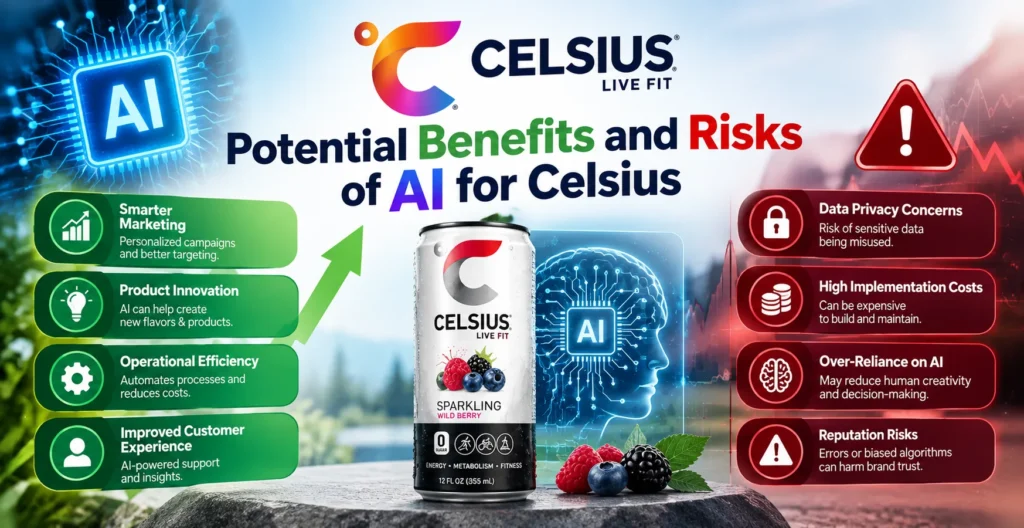
Potential Benefits and Risks of AI for Celsius
Efficiency, Marketing, and Supply Chain Planning
If Celsius or another beverage company uses suitable AI tools, potential benefits could include better demand estimates, faster analysis of consumer feedback, and improved inventory planning.
Hypothetical example: Suppose a beverage company sees sales rising during hot weather. An AI forecasting tool could combine past sales, weather forecasts, and retailer stock levels to estimate which stores may need more drinks. Staff could then review the forecast and adjust deliveries.
This illustrates a possible use of AI, not a confirmed Celsius process or a measured result.
Data Privacy, Accuracy, and Automation Risks
AI systems depend on the quality of their data. Incomplete sales records or unusual seasonal patterns can lead to poor forecasts, while biased customer data can produce misleading marketing insights.
Companies also need to protect customer information and review important automated decisions. For readers researching Celsius, the key point is to distinguish the potential benefits of AI from documented evidence of actual company use.
How Celsius Compares With Other Beverage Brands Using AI
AI applications across consumer packaged goods can include production monitoring, sales forecasting, and customer analytics. However, comparing brands accurately requires evidence that each company uses the specific technology being discussed.
Celsius Holdings has a documented strategic relationship with PepsiCo. In August 2025, the companies announced an expanded partnership involving distribution and portfolio changes; PepsiCo’s ownership increased to approximately 11% on an as-converted basis. The announcement establishes a commercial relationship, not proof that Celsius uses PepsiCo’s AI systems.
When comparing beverage brands, focus on documented technology deployments rather than assuming that partnerships, automation, or company size demonstrate AI adoption.
What Could AI Mean for Celsius in the Future?
AI could potentially support future work in product research, manufacturing quality checks, personalized marketing, and supply chain planning. These are possible applications across the beverage industry, not confirmed Celsius plans.
If the company announces an AI initiative, look for details about the technology, its intended purpose, and any reported results. Independent evidence and clearly defined measurements are more useful than broad claims that AI is transforming the business.
Frequently Asked Questions About Celsius
What is the Celsius controversy?
Celsius has faced public debate over its health-focused marketing, caffeine levels, and the way consumers understand its products. The FDA warns that excessive caffeine can cause problems such as anxiety, jitters, and sleep-related issues, while concerns about Celsius’s marketing have also been raised in media coverage.
Is Celsius actually the healthiest energy drink?
There is no single energy drink that is healthiest for everyone. Compare caffeine, sugar, serving size, sweeteners, and other ingredients, and consider your own caffeine sensitivity and health needs.
Which is better, Alani or Celsius?
The choice depends on your preferred flavors, caffeine tolerance, ingredients, and serving size. Compare the nutrition labels of the specific products rather than relying on brand reputation or marketing claims.
Does Celsius use artificial flavors?
Celsius states that its U.S. energy drinks contain no artificial flavors. Check the ingredient list on your specific product because formulations and labeling may vary by market.
How unhealthy is it to drink Celsius?
Celsius contains substantial caffeine: standard CELSIUS and CELSIUS Vibe drinks contain 200 mg per can, while CELSIUS Essentials contains 270 mg. The FDA says up to 400 mg of caffeine per day is an amount not generally associated with negative effects for most healthy adults, but individual tolerance varies, and caffeine from all sources counts toward the total.
Who is Celsius owned by?
Celsius Holdings, Inc. is the publicly traded company behind the Celsius brand. PepsiCo is a major shareholder, holding approximately 11% on an as-converted basis following the expanded strategic partnership announced in August 2025; it does not own the entire company.
Final takeaway: Whether Celsius uses AI technology is a question that should be answered with company-specific evidence, not assumptions about what modern beverage companies can do. AI could support marketing, manufacturing, and inventory planning, but claims about actual Celsius deployments or AI-created ingredients require reliable confirmation.