
Modern wearable video streaming technology delivers direct, hands-free field intelligence straight from frontline personnel to remote command centers. By combining real-time cellular bonding, high-efficiency video compression (HEVC/H.265), and secure ultra-low latency transport protocols, enterprise organizations can now stream stable 1080p and 4K live feeds from almost any environment on Earth.
- Introduction & Industry Overview
- Next-Gen Wearable Form Factors & Hardware Specs
- Low-Latency Live Streaming Protocols & Video Compression
- Advanced Network Infrastructure & Field Connectivity
- Camera Stabilization & Encoder Performance
- Power Architecture & Thermal Management
- POV Mounting Physics & Ergonomic Placement Strategy
- Enterprise Security, Encryption & Regulatory Compliance
- Industry Applications & Real-World Use Cases
- Step-by-Step Implementation Guide
- Frequently Asked Questions
Introduction & Industry Overview
The market for wearable video technology has evolved rapidly from static, local SD-card logging into real-time live streaming platforms. Early body-worn cameras functioned primarily as passive evidentiary recorders. Today, live wearable streaming serves as an active force-multiplier for public safety teams, field service engineers, and emergency medical technicians.
Deploying live wearable video requires balancing critical technical trade-offs across four primary axes:
| Engineering Parameter | High-Performance Target | Operational Trade-Off |
| Video Resolution & Bitrate | 1080p60 / 4K @ 8–12 Mbps | Spikes cellular data usage; elevates hardware thermal output |
| Cellular Latency | Sub-500ms glass-to-glass | Requires aggressive buffer reductions, risking packet dropouts |
| Battery Efficiency | Continuous 8+ hour shift life | Increases hardware weight and thermal mass |
| Thermal Dissipation | Passive cooling under $45^\circ\text{C}$ ($113^\circ\text{F}$) ambient | Requires lower processor clock speeds or external heatsinking |
Capturing first-person perspective (POV) footage provides unique strategic value across enterprise operations. By replacing subjective verbal descriptions with live, real-time visual feeds, off-site subject matter experts can remotely guide junior technicians, triage trauma patients en route to hospitals, and maintain total situational awareness during critical incidents.
Next-Gen Wearable Form Factors & Hardware Specs
Selecting the correct hardware form factor depends directly on physical movement requirements, environmental extremes, and tactical constraints.
| Wearable Form Factor | Key Capabilities | Primary Operational Environment |
| Smart Glasses (POV) | Compact optics, micro-OLED heads-up display | Line-of-sight remote inspection, guided assembly |
| Body-Worn Cameras (BWC) | Torso-mounted, heavy-duty impact resistance | Public safety, law enforcement continuous shifts |
| Action Cameras & Modular POV | High frame-rate, versatile mounting points | High-speed outdoor tasks, sports broadcasting |
| Thermal Imaging Wear | Optical + LWIR hybrid overlay | Firefighting, thermal infrastructure diagnostics |
Sensor & Optical Performance
Enterprise-grade wearables incorporate low-noise, back-illuminated CMOS sensors capable of low-light sensitivity down to $0.001\text{ lux}$. Dynamic High Dynamic Range (HDR) exposure controls prevent blown-out highlights when moving between indoor spaces and bright outdoor environments. Multi-element optical glass configurations feature anti-reflective coatings and distortion-corrected wide-angle lenses ($110^\circ\text{ to }140^\circ\text{ FOV}$) to keep adjacent operational detail crisp without “fisheye” warping.
Ruggedization & Environmental Resistance
To survive demanding field deployments, enterprise devices meet strict IP67 or IP68 ingress protection standards:
- IP67: Dust-tight; withstands total water immersion up to 1 meter for 30 minutes.
- IP68: Dust-tight; withstands continuous submersion beyond 1 meter under manufacturer-specified pressure limits.
- Hardware chassis feature magnesium-alloy internal frames, high-impact polycarbonate shells, and chemically toughened Gorilla Glass optical windows resistant to high drops and extreme vibration.
Low-Latency Live Streaming Protocols & Video Compression
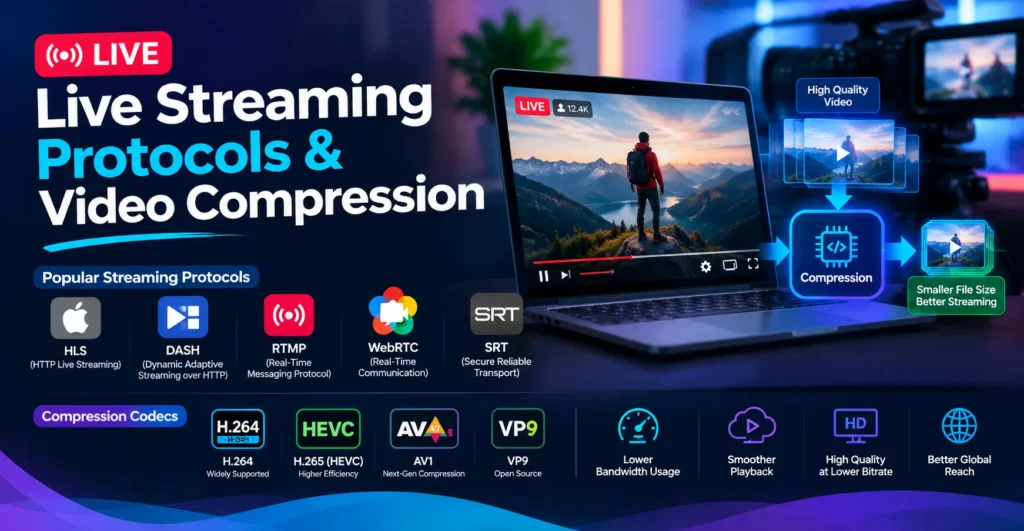
Maintaining sub-second glass-to-glass latency over public mobile networks requires optimized streaming protocols and efficient video codecs.
| Pipeline Stage | Operational Function | Technical Specification |
| Image Capture | CMOS Sensor processing | Raw 1080p/4K visual ingest |
| Edge Compression | On-device encoding | HEVC / H.265 video codec |
| Packet Transport | Ultra-low latency streaming | SRT / WebRTC protocol stack |
| Network Delivery | Multi-carrier uplinks | Bonded 5G / 4G LTE cellular path |
Protocol Comparison: RTSP vs. RTMP vs. SRT vs. WebRTC
Legacy streaming protocols struggle over unstable cellular links. Modern transport frameworks use Advanced Reliability Algorithms to prevent stream breakdown under high packet loss.
| Feature / Metric | RTSP | RTMP | SRT (Secure Reliable Transport) | WebRTC |
| Glass-to-Glass Latency | $2.0\text{s} – 5.0\text{s}$ | $1.5\text{s} – 3.0\text{s}$ | $120\text{ms} – 800\text{ms}$ | $50\text{ms} – 300\text{ms}$ |
| Transport Layer | TCP / UDP | TCP | UDP with ARQ | UDP / SCTP |
| Packet Loss Handling | Poor (Stalls) | Poor (Buffering) | Excellent (Automatic Retransmission) | Excellent (NACK / FEC) |
| Native Encryption | Optional (SRTP) | None (Requires RTMPS) | AES-128 / AES-256 Built-In | DTLS / SRTP Enforced |
| Network Efficiency | Low | Moderate | High (Low Retransmission Overhead) | High (Adaptive Bitrate) |
Video Compression: H.264 vs. HEVC / H.265
Deploying HEVC / H.265 compression provides a ~50% reduction in bitrate requirements compared to legacy H.264 at identical visual quality. In bandwidth-constrained environments, streaming a 1080p30 feed requires 4.0 Mbps using H.264, whereas H.265 maintains equivalent clarity at 1.8 to 2.2 Mbps. This bitrate efficiency directly minimizes cellular data costs and prevents stream stuttering during network dropouts.
AI-Assisted Bandwidth Adaptation
Modern wearable platforms integrate AI edge encoders that analyze real-time network throughput, ping jitter, and packet drop metrics every frame. When network quality degrades, the encoder dynamically adjusts parameters without dropping the session:
- Dynamic Resolution Scaling: Automatically lowers stream raster resolution (e.g., 1080p down to 720p).
- Keyframe Interval Adjustment: Extends or shortens Group of Pictures (GOP) structure length dynamically.
- Quantization Parameter (QP) Tuning: Intelligently allocates bandwidth to high-priority image zones (such as face regions or text labels) while compressing background details.
Advanced Network Infrastructure & Field Connectivity

Relying on a single cellular modem creates a single point of failure in dense urban centers or remote operational zones.
Cellular Bonding Architecture
Multi-SIM cellular bonding aggregators combine throughput from multiple independent cellular carriers (e.g., AT&T, Verizon, T-Mobile) alongside active Wi-Fi 6E uplinks into a single logical pipe.
- Source Layer: Wearable Encoding Camera captures and compresses live video feed.
- Aggregated Network Paths:
- Carrier A: Primary 5G SIM connection
- Carrier B: Secondary 4G LTE SIM backup connection
- Wi-Fi Uplink: Local Wi-Fi 6E node (where available)
- Destination Layer: Cloud or On-Premise Bonded Server reassembles encapsulated UDP packets into a seamless live stream.
By splitting live streams at the packet level using encapsulation algorithms, bonded systems maintain uninterrupted video feeds even if two carriers drop connectivity completely.
Edge Computing Nodes & Buffer Fallbacks
In enterprise network architectures, regional edge computing nodes sit close to cellular towers. These nodes handle stream decryption, real-time AI metadata extraction (such as license plate recognition or facial redacting), and protocol transcoding before forwarding streams to main Video Management Systems (VMS).
When complete network blackouts occur, internal high-speed flash buffers temporarily record raw video locally. Once connectivity is restored, the buffer seamlessly backfills missing timeline segments into the central server without interrupting the active live feed.
Camera Stabilization & Encoder Performance
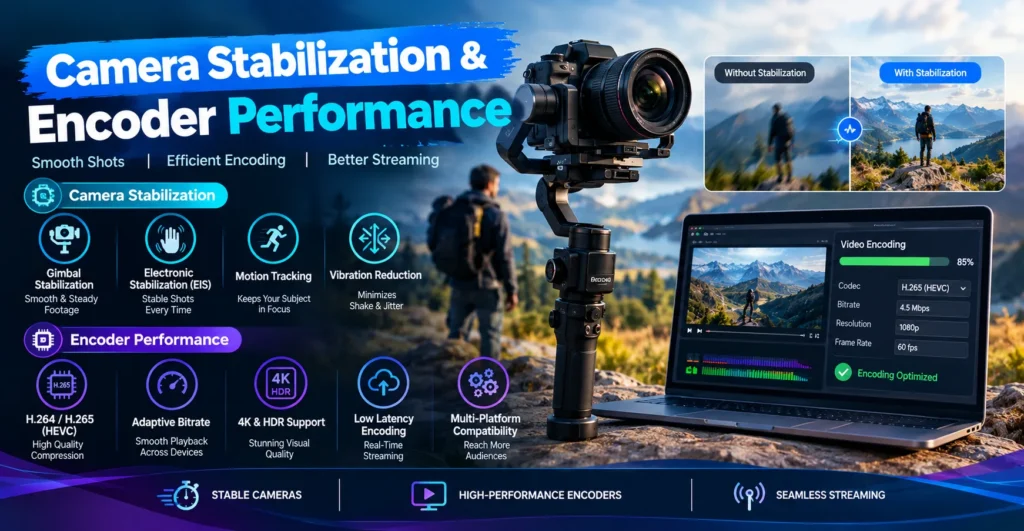
Physical movement poses a major challenge to live video encoders. Continuous camera shaking introduces high frame-to-frame pixel variance, forcing software encoders to spike bitrates to prevent heavy image pixelation.
Electronic Image Stabilization (EIS) vs. Hardware Gimbals
- Hardware Gimbals: Provide high mechanical stabilization but add significant physical weight, moving parts, and battery drain to head-worn setups.
- Advanced Multi-Axis EIS: Utilizes high-frequency 6-axis Gyroscope/Accelerometer IMU data to crop and smooth image frames in real time before sending them to the encoder pipeline.
Stabilization Impact on Encoder Efficiency
When a camera bounces during running or climbing, non-stabilized video forces the encoder to treat almost every pixel as a motion vector change. This causes the bitrate to instantly surge from 2 Mbps to over 8 Mbps. On constrained cellular uplinks, this sudden demand triggers heavy buffer bloat and frozen frames. EIS smooths out high-frequency vibrations, keeping the required bitrate low and enabling stable live streams over weak cellular connections.
Power Architecture & Thermal Management
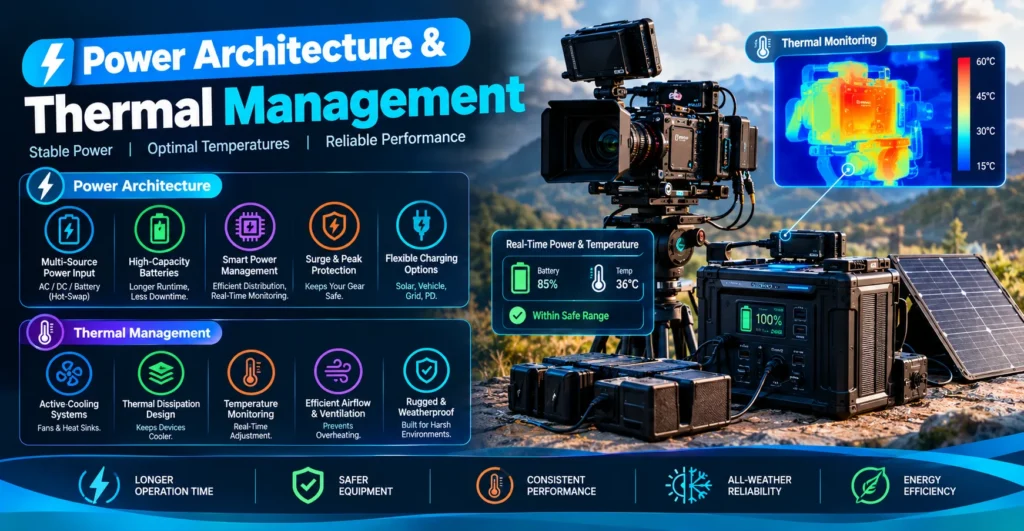
Small form-factor cameras generate substantial internal heat when processing continuous high-bitrate H.265 encodes and 5G packet transmissions simultaneously.
Battery Power Bypass Routing
| Component Stage | System Action | Thermal Result |
| Power Source | External Power Bank delivers DC current | Zero power dissipation at camera battery level |
| Management IC | Bypass Management IC routes power directly to CPU | Eliminates internal battery charging heat ($0^\circ\text{C}$ rise) |
| System CPU | Continuous H.265 encoding & 5G transmission | Stable processor temperature below junction limits |
| Hot-Swap Cell | Internal battery stays fully charged in standby | Available for instant hot-swap detachment |
Active & Passive Thermal Mitigation
Without effective thermal design, wearable processors hit junction temperature limits ($85^\circ\text{C}$ to $105^\circ\text{C}$) within 20 minutes of continuous 1080p60 streaming, triggering thermal shutdowns. Advanced wearable engineering uses:
- Passive Copper Vapor Chambers: Spread localized CPU/cellular module heat evenly across the device’s exterior chassis.
- Thermal Interface Materials (TIM): Graphite sheets and phase-change pads that direct heat away from delicate internal battery chemistry.
- Power Bypass Electronics: Circuits that power the system directly from external power banks without routing through the internal battery, preventing localized battery heating during operation.
Hot-Swappable Battery Protocols
To keep units operating across full 12-hour shifts, wearable systems incorporate internal supercapacitors or small secondary backup cells. Field operators can swap out primary high-capacity battery packs without powering down the device, losing network handshakes, or dropping active live streams.
POV Mounting Physics & Ergonomic Placement Strategy
Proper ergonomics and microphone placement ensure comfortable all-day wear and clear audio-visual capture in extreme operational environments.
Ergonomics & FOV Calibration
Mounting heavy cameras high on a helmet introduces high rotational neck torque, accelerating wearer fatigue. Positioning primary weight near the user’s natural center of gravity (such as mid-chest or upper sternum) improves long-term comfort. Lenses must be calibrated to match the user’s task workspace:
- Close-up Remote Inspection: $70^\circ – 90^\circ\text{ FOV}$ prevents barrel distortion and keeps fine print readable.
- Tactical Law Enforcement / EMS: $120^\circ – 140^\circ\text{ FOV}$ captures full peripheral context and hands-in-frame activity.
High-Noise Audio Capture
Capturing clear dialogue in high-noise environments (such as near industrial machinery or windy flightlines) requires specialized hardware audio design:
- Dual-Array Directional Microphones: Form targeted beamforming pickup patterns toward the wearer’s mouth while dampening ambient background noise.
- Active Wind-Noise Suppression: Combines physical acoustic mesh barriers with digital signal processing (DSP) filters to cut low-frequency wind rumble.
- Bluetooth Intercom Integration: Pairs directly with push-to-talk (PTT) headsets or tactical ear-pro systems, delivering clean two-way audio streams over the live video channel.
Enterprise Security, Encryption & Regulatory Compliance
Live enterprise video streams contain sensitive tactical, personal, or healthcare data, making robust data security essential.
Security Framework Comparison
| Compliance & Security Standard | Target Application | Regulatory Requirement | System Architecture |
| AES-256 Encryption | All Enterprise / Public Streams | End-to-end data encryption in transit and at rest | Hardware AES crypto-engine on camera SOC |
| CJIS Compliance | Law Enforcement & Public Safety | FBI security mandates for handling Criminal Justice Information | Audit logging, dual-factor auth, strict access policies |
| HIPAA Compliance | Telemedicine & EMS First Responders | Protecting Patient Health Information (PHI) during live streams | Real-time face redacting, encrypted cloud VMS storage |
| Chain of Custody Data Integrity | Evidentiary Video Management | Preventing video tampering or unauthorized editing | Cryptographic SHA-256 hash validation on every video frame |
For high-security operations, local SD cards automatically encrypt recorded video buffers using hardware-locked keys. If a wearable device is lost or captured in the field, unauthorized users cannot extract raw footage directly from internal storage modules.
Industry Applications & Real-World Use Cases
| Sector | Deployment Model | Operational Impact |
| Public Safety & Law Enforcement | Tactical body-worn feeds | Real-time situational awareness and dispatch integration |
| First Responders / EMS | Point-of-care remote video | Live trauma diagnostic streaming to hospital specialists |
| Industrial Operations | Hands-free remote assist | Instant expert guidance and maintenance verification |
| Live Sports & Media | POV athlete/referee streams | Immersive first-person multi-view event integration |
Step-by-Step Implementation Guide
Follow this operational deployment workflow to deploy enterprise-grade wearable video streaming across field teams:
| Phase | Operational Step | Key Technical Deliverables |
| Phase 1: Network & Protocol Setup | Configure SRT / WebRTC Ingest Gateways | Set up cloud or on-premises streaming servers with AES-256 encryption keys and dynamic buffer targets ($200\text{ms} – 500\text{ms}$). |
| Phase 2: Hardware Provisioning | Calibrate Multi-SIM Cellular Aggregators | Install active SIM cards across two or more distinct cellular networks; test bonding failover parameters. |
| Phase 3: Mounting & FOV Alignment | Ergonomic Fitment & Lens Calibration | Adjust chest/helmet harnesses for center-of-gravity balance; verify lens angle matches operational workspace requirements. |
| Phase 4: Field Testing & Optimization | Thermal & Bandwidth Stress Testing | Run continuous 60-minute streams over 1080p60 H.265 feeds to confirm battery thermal limits and dynamic bitrate scaling. |
Frequently Asked Questions
What is the best wearable camera for live streaming?
The best wearable camera depends directly on your operational environment. For hands-free technical inspection, smart glasses like the RealWear Navigator or Vuzix Blade offer optimized line-of-sight POV capture. For public safety and field operations, cellular-bonded body-worn cameras from vendors like Axon, Digital Barriers, or Action Streamer deliver rugged IP68 protection, extended battery life, and secure low-latency transport.
How much do streaming cameras cost?
Pricing ranges widely based on hardware capabilities and software ecosystems. Entry-level consumer action cameras with simple single-carrier Wi-Fi/cellular streaming start between $300 and $600. Enterprise-grade, IP68-rated wearable systems featuring multi-SIM cellular bonding, AES-256 encryption, and dedicated VMS cloud integration typically range from $1,500 to $4,500 per unit, plus ongoing software licensing fees.
Can wearable cameras record audio?
Yes, professional wearable cameras record high-quality audio along with video feeds. Enterprise models feature dual-array directional microphones, active DSP wind-noise suppression, and ambient noise cancellation to capture clear dialogue in high-noise industrial or field environments. Many units also support Bluetooth pairing with tactical ear protection and external headsets.
Is there a camera that can live stream?
Yes, modern standalone wearable cameras can stream live directly to cloud servers or local VMS platforms. Enterprise models integrate built-in cellular modems or multi-SIM bonding hardware, allowing them to broadcast high-definition video over 5G/4G LTE networks without needing a tethered smartphone.
Are wearable cameras legal?
Wearable camera usage is generally legal in public spaces and authorized work environments, but deployments must comply with regional privacy laws. Organizations must adhere to local wiretapping and consent regulations regarding audio recording, maintain clear workplace policies, protect personal health information under standards like HIPAA where applicable, and establish strict data retention rules to ensure full legal compliance.