
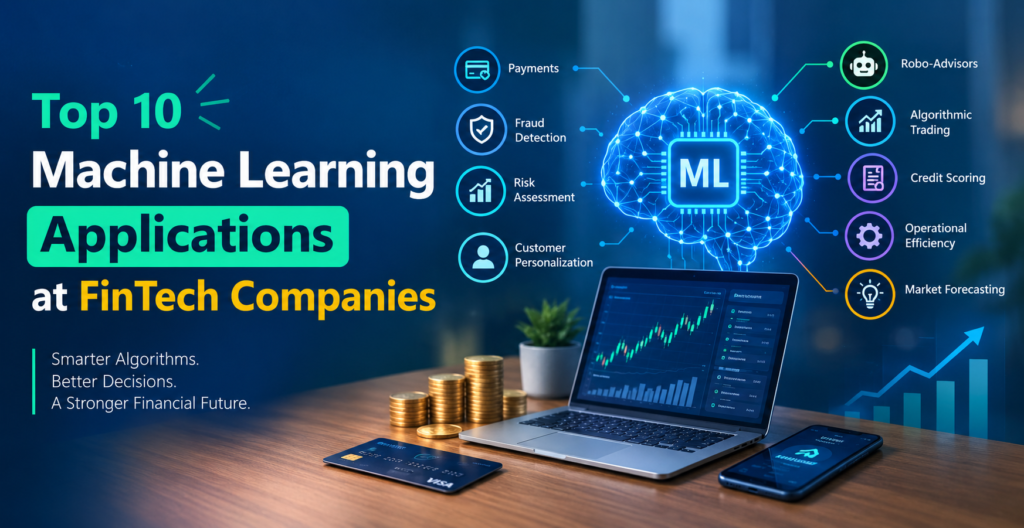
Machine learning applications at FinTech companies help detect fraud, assess credit risk, automate compliance, improve payments, and deliver personalized financial services. These systems analyze financial data to identify patterns, predict risks, and support faster decisions. Their value depends on reliable data, careful testing, and responsible use.
- What Is Machine Learning in Fintech?
- What Are the 10 Major Machine Learning Applications at FinTech Companies?
- Which Machine Learning Models Do FinTech Companies Use?
- Real-World Machine Learning in Fintech: The Monzo Example
- Benefits and Limitations of Machine Learning in Fintech
- How FinTech Companies Implement Machine Learning
- Frequently Asked Questions
- Conclusion: Choosing the Right Machine Learning Application for Fintech
What Is Machine Learning in Fintech?
Machine learning (ML) is a type of artificial intelligence that allows computer systems to learn patterns from data and use them to make predictions. In financial services, models can analyze transactions, repayment records, spending habits, and market activity.
Unlike traditional rule-based systems, which follow fixed instructions, ML models can identify complex patterns that may be difficult to describe with simple rules. For example, a bank might use a rule to flag payments above a fixed amount, while an ML model considers several signals to estimate whether a transaction is suspicious.
Fintech companies also use predictive analytics, natural language processing (NLP), cloud computing, and automation. Generative AI can summarize financial documents or answer customer questions, while predictive ML models can estimate fraud risk or the likelihood of loan default.
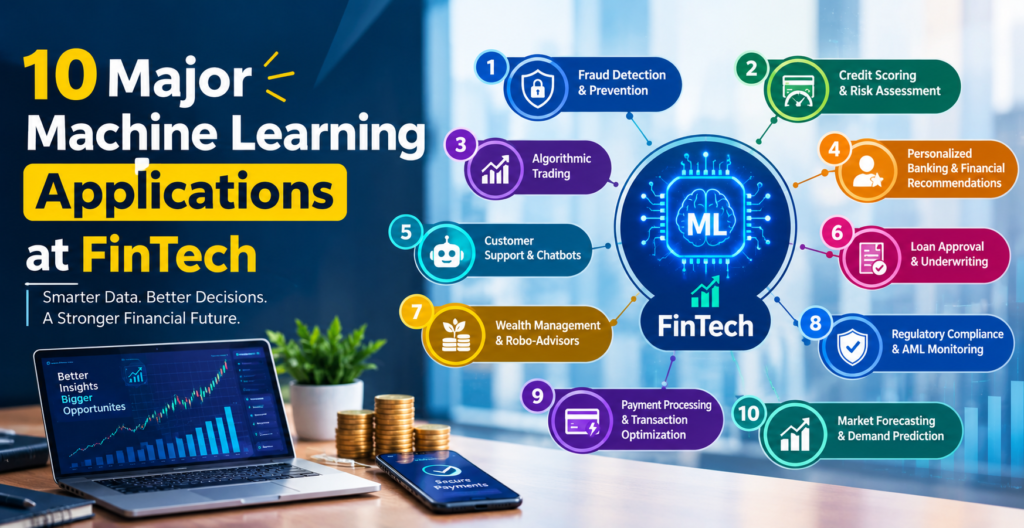
What Are the 10 Major Machine Learning Applications at FinTech Companies?
1. AI-Powered Fraud Detection and Real-Time Transaction Monitoring
ML models analyze transaction amounts, locations, device details, payment frequency, and past behavior to identify suspicious activity. A risk score can help a payment provider approve a transaction, request additional verification, or send it for review.
False positives occur when legitimate transactions are flagged as fraud. False negatives occur when fraudulent transactions go undetected. Fintech companies must balance these risks to protect customers without blocking too many genuine payments.
2. Predictive Credit Scoring and Alternative Credit Data
Lenders use ML to estimate whether applicants are likely to repay loans. Models may analyze repayment history, existing debt, income information, and other legally permitted financial data.
Alternative credit data can help assess applicants with limited traditional credit histories. However, companies must test for bias, protect personal information, and avoid using unreliable or inappropriate signals in lending decisions.
3. Anti-Money Laundering (AML) and Know Your Customer (KYC) Automation
ML supports anti-money laundering programs by identifying unusual transactions, suspicious account relationships, and patterns that may require investigation. KYC systems can also use document recognition and identity verification to help confirm customer information.
These tools help compliance teams prioritize alerts, but an unusual transaction does not automatically prove financial crime. Human investigators still need to review evidence and follow applicable reporting requirements.
4. Predictive Risk Analytics and Loan Default Prediction
Financial companies use predictive risk analytics to estimate credit, market, and operational risks. Loan models can identify patterns associated with missed payments and help lenders detect possible repayment problems earlier.
These predictions can support appropriate customer assistance and risk planning. They should not replace fair lending practices or justify treating customers unfairly based on uncertain forecasts.
5. Algorithmic Trading and Investment Risk Analysis
ML models analyze market prices, trading volume, historical patterns, and other permitted data to identify potential trading signals. Investment teams can also use predictive models to examine risk and test strategies against historical data.
Backtesting helps assess how a strategy might have performed in the past, but it cannot guarantee future returns. Transaction fees, market changes, and unexpected events can reduce or eliminate expected gains.
6. Payment Processing and Chargeback Prediction
Payment providers use ML to assess transaction risk, support authorization decisions, identify risky merchants, and estimate the likelihood of chargebacks. These insights can help payment systems make decisions quickly while directing suspicious activity for further checks.
Models need to account for both fraud losses and the cost of declining legitimate payments. Performance should be measured using real business outcomes, not just the number of suspicious transactions detected.
7. Robo-Advisors and Portfolio Optimization
Robo-advisors use software to help customers build and manage investment portfolios. ML can support risk profiling, market analysis, personalized recommendations, and portfolio monitoring.
Automated systems may also suggest portfolio adjustments as customer goals or market conditions change. Investment recommendations still require suitable risk controls, and no model can guarantee investment profits.
8. Personalized Financial Recommendations and Cash-Flow Forecasting
ML can categorize spending, identify recurring payments, and estimate future cash flow from transaction history. A personal finance app might alert a user when predicted expenses could leave less money available before payday.
These features can make budgeting more useful by turning transaction records into timely insights. Recommendations should be based on relevant data and clearly communicated assumptions.
9. NLP-Powered Customer Service and Financial Document Analysis
Natural language processing helps fintech companies classify customer questions, analyze complaints, and route transaction-related requests. Generative AI can summarize statements, extract information from financial documents, and help support agents find relevant details.
Sensitive cases, disputed transactions, and complex financial questions may require human review. AI-generated answers should also be checked for accuracy before they influence important financial decisions.
10. Cybersecurity, Account Takeover Detection, and Insurtech
ML models can flag unusual login times, unfamiliar devices, unexpected location changes, or behavior that differs from a customer’s normal account activity. These signals can help security teams detect potential account takeovers.
In insurance, ML supports underwriting, claims triage, fraud detection, and risk assessment. Insurers must still consider data quality, privacy, fairness, and the legal rules governing automated decisions.
Which Machine Learning Models Do FinTech Companies Use?
Different financial problems require different models. The choice depends on the available data, required prediction speed, level of transparency, and cost of making an incorrect decision.
Common ML Models and Their Financial Applications
| ML model | Common fintech application | Main strength | Key limitation |
|---|---|---|---|
| Logistic regression | Credit scoring and default prediction | Easy to interpret | May miss complex patterns |
| Decision trees | Lending decisions and risk classification | Clear decision paths | Can overfit training data |
| Random forests | Fraud detection and risk assessment | Captures complex relationships | Harder to explain than a single tree |
| Gradient boosting | Fraud scoring and credit-risk prediction | Strong performance on many structured datasets | Requires careful tuning and monitoring |
| Clustering | Customer segmentation and anomaly investigation | Finds groups without predefined labels | Unusual groups are not always fraudulent |
| Neural networks | Complex transaction patterns and document processing | Learns complex relationships | Can require more data and computing resources |
Fintech teams should select models based on validated performance, operational needs, and the consequences of errors. A simpler, interpretable model may be more appropriate for a regulated lending decision than a more complex model with little added value.
How to Measure Machine Learning Model Performance
Accuracy alone can be misleading when fraud is rare. A model that labels nearly every transaction as legitimate could appear highly accurate while missing much of the fraud.
- Precision: Of the transactions flagged as suspicious, how many were actually suspicious?
- Recall: Of all known fraudulent transactions, how many did the model identify?
- Precision-recall AUC: How well does the model balance precision and recall across different decision thresholds?
- False-positive rate and latency: How often are legitimate cases incorrectly flagged, and how quickly does the model return a result?
The right balance depends on the use case. Payment fraud systems may prioritize fast decisions, while credit scoring also requires careful fairness testing and reliable explanations.
Real-World Machine Learning in Fintech: The Monzo Example
Monzo, a digital bank, has been discussed in an MLOps Talks engineering case study featuring Neal Lathia. The discussion covers machine learning in banking, including customer service, fraud detection, credit scoring, and the challenges of operating models in production.
One practical lesson is that ML should not automatically replace existing rules. Simple rules can work well for clear, predictable situations, while ML can add value when many signals interact, or patterns change over time.
For example, a fintech company could use a fixed rule to block a transaction that violates a clear security requirement and an ML model to score other transactions for suspicious behavior. This is an illustrative approach, not a claim about Monzo’s exact production architecture.
The broader lesson is to plan for deployment, monitoring, and maintenance from the beginning. A model that performs well in a test environment still needs to work reliably within real banking systems.
Benefits and Limitations of Machine Learning in Fintech
Key Benefits for Financial Technology Companies
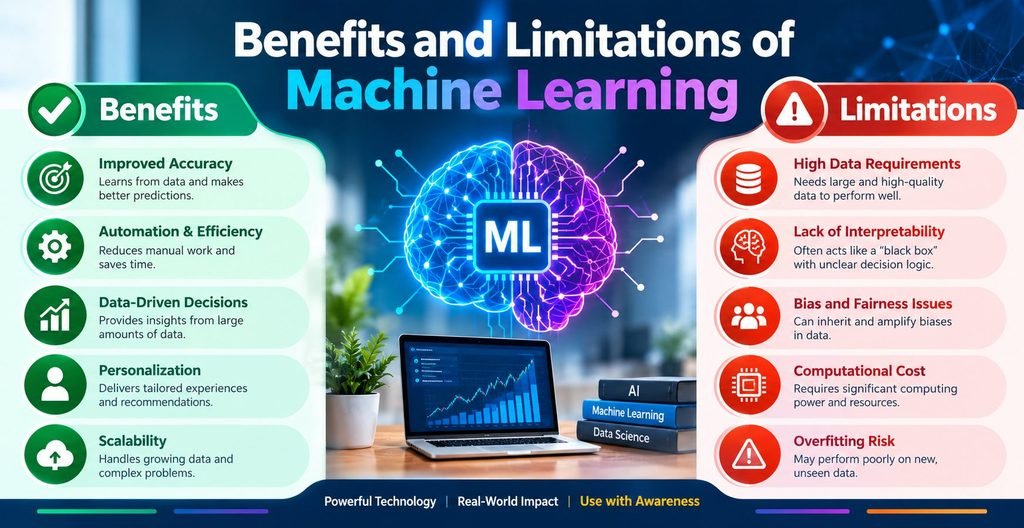
Machine learning can help financial businesses process large datasets, detect unusual behavior, assess risk, and personalize services. Automated predictions can also reduce repetitive work and help employees focus on cases that need attention.
The main benefits depend on the problem being solved. Better fraud detection may reduce losses, while more useful cash-flow forecasts may help customers plan their spending.
Risks, Bias, Privacy, and Explainable AI
ML systems can reproduce unfair patterns in historical data. For example, a credit model may perform differently across customer groups, even when its overall accuracy appears acceptable.
Fintech companies should protect sensitive information through encryption, access controls, data minimization, and clear retention policies. They should also test model performance across relevant groups and maintain records of important decisions.
Explainable AI (XAI) helps people understand why a model produced a prediction. Tools such as feature importance and SHAP can show which inputs contributed to a result, but an explanation alone does not prove that a model is fair or correct.
Financial businesses must also follow the laws and regulatory requirements that apply to their products and jurisdictions. Automated decisions need suitable oversight, documentation, and review procedures.
How FinTech Companies Implement Machine Learning
The Machine Learning Implementation Workflow
A practical implementation starts with a clear business problem rather than choosing an algorithm first.
- Define the goal: For example, reduce fraudulent payment losses without increasing legitimate declines.
- Prepare the data: Collect permitted, relevant data, correct errors, handle missing values, and create useful features.
- Build a baseline: Measure the performance of the current rules or process before introducing ML.
- Train and validate: Compare suitable models using data that reflects real operating conditions, avoiding data leakage.
- Integrate gradually: Test the model with limited traffic or in a monitoring-only mode before allowing it to affect live decisions.
- Measure business impact: Track fraud losses, false positives, customer experience, processing speed, and operating costs.
Fintech companies can build models internally or purchase third-party solutions. Building offers more control but requires data scientists, engineers, infrastructure, security, and ongoing maintenance. Buying may speed up deployment, but the company still needs to assess vendor reliability, integration, data handling, and compliance.
There is no universal implementation cost. The total depends on the problem’s complexity, data readiness, computing requirements, staffing, and regulatory obligations.
Model Drift Monitoring and MLOps
Model performance can decline when customer behavior, economic conditions, or fraud techniques change. This is known as model drift, although changes in incoming data and changes in the relationship between inputs and outcomes are distinct problems.
MLOps practices help teams manage models throughout their life cycle. A production monitoring plan should cover:
- Data quality, prediction performance, response latency, and drift alerts.
- Model versions, access permissions, incident response, and retraining criteria.
- Rollback procedures for models that produce unsafe or unreliable results.
Retraining should follow evidence and validation rather than an automatic schedule alone. Each updated model should be tested before replacing the version currently in use.
Frequently Asked Questions
What are 10 applications of machine learning?
Ten applications include fraud detection, credit scoring, AML and KYC automation, risk prediction, algorithmic trading, payment processing, robo-advisors, personalized financial recommendations, customer service, and cybersecurity. Insurance companies also use ML for underwriting and claims analysis.
How is AI being used in fintech?
AI helps fintech companies detect suspicious transactions, assess credit risk, automate customer support, analyze documents, and personalize financial services. Machine learning supports predictions from data, while generative AI helps create or summarize text and other content.
What are the 5 key technologies in fintech?
Five key technologies are artificial intelligence and machine learning, blockchain, cloud computing, robotic process automation, and application programming interfaces (APIs). They support different functions, from financial predictions and secure records to scalable infrastructure and system integration.
What are some examples of machine learning applications in finance?
Examples include identifying unusual card payments, predicting loan defaults, forecasting cash flow, detecting suspicious account activity, and supporting investment analysis. These applications use data to produce predictions or alerts that support financial decisions.
Is ChatGPT AI or ML?
ChatGPT is an artificial intelligence (AI) system powered by large language models developed using machine learning (ML). It generates responses based on patterns learned during training and additional model development, but its answers can still contain errors.
Conclusion: Choosing the Right Machine Learning Application for Fintech
Machine learning applications at FinTech companies can improve fraud detection, credit assessment, payment processing, customer service, and financial risk management. Their success depends on selecting the right use case, using reliable data, and measuring results against clear business goals.
Fintech teams should start with one defined problem, establish a baseline, test suitable models, and monitor performance after deployment. Fairness, privacy, explainability, and regulatory compliance should remain part of the process from the beginning.
The goal is not to use the most complex model. It is to build a reliable system that solves a real financial problem while protecting customers and supporting sound decisions.