
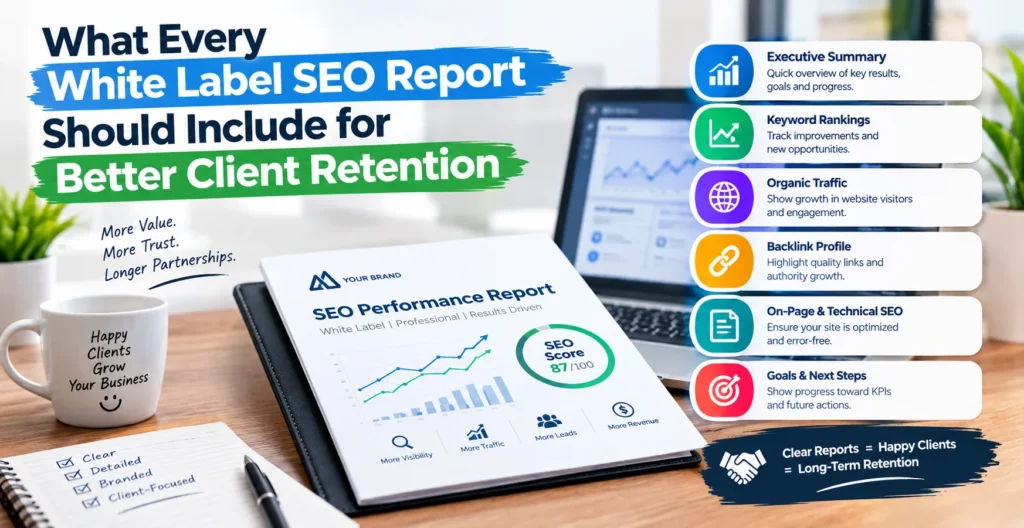
SEO clients want more than a list of numbers at the end of each month. They want to know what was done, what changed, whether their website is moving in the right direction, and what will happen next. A well-prepared white label seo report gives agencies a simple way to explain SEO progress while keeping the focus on the client’s business goals.
A report can also influence whether a client decides to continue working with an agency. Even when SEO work is producing good results, poor reporting can make those results difficult to understand. On the other hand, a clear report can show the work behind the results and help clients see the value of an ongoing SEO campaign.
- Why SEO Reports Matter for Client Retention
- Start With a Simple Executive Summary
- Connect SEO Results With Business Goals
- Show Organic Traffic Clearly
- Include Important Keyword Movement
- Explain the Work Completed During the Month
- Show Which Pages Are Performing
- Make Technical SEO Easy to Understand
- Include Conversion Data Where Available
- Don't Hide Problems
- Add a Clear Next-Step Plan
- Use Visuals Without Overloading the Report
- Keep Reporting Consistent
- Personalize Reports for Each Client
- What Makes a Report More Valuable?
- Common Reporting Mistakes Agencies Should Avoid
- How Better Reporting Can Improve Client Retention
- Frequently Asked Questions
- Conclusion
Why SEO Reports Matter for Client Retention
SEO is not always easy for clients to understand. Rankings can move up and down, traffic can change from month to month, and some improvements may take several months to produce visible results.
Without regular communication, clients may start wondering what their monthly investment is achieving. A useful report gives agencies an opportunity to answer those questions before they become concerns.
The goal should not be to fill a report with every available SEO metric. The goal is to present the information that helps the client understand progress and make better decisions.
Start With a Simple Executive Summary
The first section should quickly tell the client what happened during the reporting period.
A business owner may not have time to study every chart or table. They should be able to open the report and understand the main results within a few minutes.
The summary can explain the most important improvements, challenges, completed work, and next steps in straightforward language.
For example, instead of simply showing that organic traffic increased by 18%, explain what contributed to that increase and whether the traffic came from pages that matter to the business.
Connect SEO Results With Business Goals
A report becomes more useful when SEO performance is connected to the client’s actual goals.
A local business may care about phone calls, enquiries, direction requests, and local visibility. An online store may be more interested in product traffic, sales, and revenue.
This means the report should not look exactly the same for every client.
Before creating the report, agencies should understand what success means for that particular business. This allows the reporting to focus on information that the client can actually use.
Show Organic Traffic Clearly
Organic traffic remains an important part of most SEO campaigns, but simply showing a traffic number is not enough.
The report should help clients understand whether traffic is increasing, decreasing, or staying relatively stable. It can also show which pages are attracting visitors and whether the traffic is coming from useful search queries.
Looking at trends over time is often more helpful than focusing only on one month’s number.
A temporary drop does not necessarily mean that an SEO campaign is failing. Seasonal changes, algorithm updates, website changes, and other factors can affect traffic.
Include Important Keyword Movement
Keyword rankings can help clients understand how their visibility in search results is changing.
However, reporting hundreds of keywords without context can make the report difficult to read. Focus on keywords that are important to the client’s services, products, locations, and business goals.
The report can highlight keywords that have improved significantly, keywords that have lost positions, and new search terms where the website has started gaining visibility.
This gives clients a clearer picture of how the SEO campaign is affecting search performance.
Explain the Work Completed During the Month
One of the most important parts of an SEO report is showing what the agency actually did.
Clients may not see technical improvements, content updates, internal linking, keyword research, or other work happening behind the scenes.
The report should briefly explain the major tasks completed during the reporting period.
Useful Items to Include in the Work Summary
- Content published or updated
- Technical SEO improvements
- Important pages optimized
- Internal linking work
- Backlink or digital PR activity
- Local SEO improvements
- Keyword research and targeting
The list should focus on meaningful work rather than trying to make the report look busy. A short explanation of important tasks is usually more valuable than a long list of minor actions.
Show Which Pages Are Performing
Website-level traffic numbers do not tell the whole story.
A client may have one service page that has started attracting significantly more visitors while other pages remain unchanged. Showing these page-level changes can help clients understand where SEO is producing results.
Agencies can highlight pages that gained traffic, improved rankings, attracted new keywords, or started appearing for valuable searches.
This information can also help determine which pages deserve additional work in the following month.
Make Technical SEO Easy to Understand
Technical SEO can be difficult for non-technical clients.
Terms such as crawl errors, indexing, redirects, structured data, canonical tags, and page performance may mean very little to a business owner without additional explanation.
A good report should explain technical issues in terms of their potential effect on the website.
Instead of simply writing “12 indexing issues fixed,” explain what the issue was, what was changed, and why the fix matters.
This makes technical SEO feel more relevant to the client.
Include Conversion Data Where Available
Traffic and rankings are useful, but clients ultimately care about business results.
If tracking is properly configured, the report should include relevant conversion information. This could include contact form submissions, phone calls, purchases, bookings, downloads, or other important actions.
Showing the relationship between search visibility and conversions can make SEO reporting much more meaningful.
For example, ranking improvements are useful, but showing that more visitors from relevant searches completed an enquiry gives the client a stronger reason to continue investing in SEO.
Don’t Hide Problems
Not every month will produce positive results.
A sudden ranking drop, traffic decline, technical problem, or unsuccessful content campaign should not simply disappear from the report.
Being honest about problems can actually strengthen the client relationship. Explain what happened, what the agency believes caused it, and what action will be taken next.
Clients are more likely to trust an agency that communicates openly than one that only reports good news.
Add a Clear Next-Step Plan
A report should not end with last month’s results.
Clients also want to know what happens next.
The final section can outline the main priorities for the upcoming month. These could include creating new content, improving existing pages, targeting additional keywords, fixing technical issues, or strengthening local visibility.
A Strong Next-Month Plan Can Include
- The main SEO priorities for the next period
- Pages that need further improvement
- New content opportunities
- Technical issues to address
- Important keywords to target
- Expected areas of focus
This gives the client confidence that the campaign has a clear direction rather than simply repeating the same activities every month.
Use Visuals Without Overloading the Report
Charts can make SEO information easier to understand, especially when showing changes over several months.
However, adding too many graphs can have the opposite effect. Clients should not need to study ten different charts to find the information that matters.
Use visuals where they help explain a trend. Keep supporting text short and explain what the client should notice.
A clean report is often more effective than a report filled with every available SEO metric.
Keep Reporting Consistent
Consistency makes monthly reports easier to understand.
If the structure changes completely every month, clients may struggle to compare results. Agencies should maintain a familiar reporting format while updating the information based on the client’s current priorities.
For example, the main sections can remain consistent while the highlighted metrics and insights change according to campaign progress.
This creates a predictable reporting experience without making every report feel identical.
Personalize Reports for Each Client
Using the same report for every client can save time, but completely generic reports can make clients feel like they are receiving a template rather than a service.
The solution is to keep the basic reporting process consistent while personalizing the important parts.
Mention the client’s business goals, key services, important locations, recent work, and specific results.
Even small changes can make a report feel much more relevant.
What Makes a Report More Valuable?
The strongest SEO reports answer three basic questions:
What happened?
Show the most important changes in traffic, rankings, visibility, conversions, and website performance.
Why did it happen?
Explain the work completed and the factors that may have influenced the results.
What happens next?
Give the client a clear plan for the next stage of the campaign.
When these three questions are answered, the report becomes more than a collection of statistics. It becomes part of the agency-client conversation.
Common Reporting Mistakes Agencies Should Avoid
Some agencies make reporting unnecessarily complicated.
One common problem is including too many metrics. Clients can become overwhelmed when a report contains dozens of numbers without explaining which ones actually matter.
Another problem is focusing entirely on rankings. Rankings are useful, but they do not always show whether the campaign is generating valuable business results.
Agencies should also avoid using unexplained technical language. If a client does not understand the report, even strong SEO work may appear less valuable.
How Better Reporting Can Improve Client Retention
Client retention depends on several factors, including results, communication, service quality, and trust.
Reporting contributes to all of these areas. When clients regularly see what has been achieved and understand what the agency is working toward, they have a clearer reason to continue the relationship.
Good reporting also creates opportunities for useful conversations. Instead of discussing SEO only when a problem occurs, agencies can use monthly reports to discuss new opportunities and priorities.
Over time, this can turn reporting into an important part of the agency’s client retention strategy.
Frequently Asked Questions
What should an SEO report include?
An SEO report should normally include important traffic trends, keyword movement, completed work, page performance, technical improvements, conversions where available, key insights, and next steps.
How often should SEO reports be sent to clients?
Monthly reporting is common because it gives enough time for meaningful changes to appear while keeping clients regularly informed.
Should an SEO report include every keyword?
No. It is usually better to focus on relevant and valuable keywords rather than overwhelming clients with hundreds of rankings.
Should SEO reports include conversions?
Yes, whenever reliable conversion tracking is available. Business actions such as enquiries, calls, bookings, and sales can help clients understand the real value of SEO.
Can agencies automate white label SEO reporting?
Yes. Agencies can use reporting platforms and automated data collection to reduce manual work. However, reports should still include human-written insights and recommendations so clients understand what the numbers mean.
Conclusion
An effective SEO report should make complicated information easier for clients to understand. It should show what changed, explain why those changes matter, demonstrate the work completed, and provide a clear plan for what comes next.
For agencies, the purpose of a white label seo report is not simply to deliver monthly statistics. It is an opportunity to demonstrate value, maintain transparency, and keep clients involved in the SEO process.
When reports are clear, personalized, honest, and connected to business goals, clients have a better understanding of the work being done for them. That understanding can build trust and give agencies a stronger foundation for long-term client relationships.
Want to provide clients with clear, professional SEO reports without adding more reporting work to your agency’s workload? Explore Brand White Label’s white label SEO reporting solutions to see how your agency can streamline client reporting.