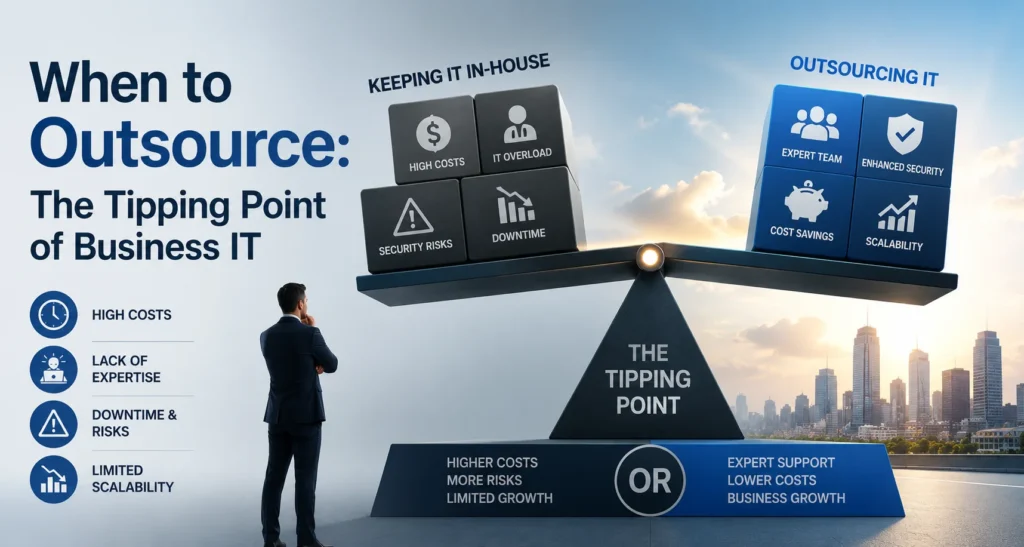
As your business scales, managing technology in-house quickly morphs from a minor daily nuisance into a massive operational bottleneck. A setup that worked for ten employees will buckle under the weight of fifty. You cannot afford to have your leadership team troubleshooting server errors or managing software updates when they should be driving revenue.
In-House and Downtime
Many business leaders assume the primary cost of internal IT is simply their technician’s salary. The reality is much darker. The true expense of a traditional “break-fix” setup reveals itself when critical systems go offline, bringing your entire operation to a standstill.
During a network outage, your payroll continues to run while production completely stops. You suffer immediate lost revenue, face potential reputational damage, and deal with incredibly frustrated customers. Every minute counts when technology fails. Waiting hours for a small internal team to research and patch a fix is unacceptable for a modern, growing company.
The ripple effects of downtime spread far beyond the IT department. Sales teams cannot process orders, customer service representatives cannot access account histories, and warehouse staff cannot print shipping labels. This organizational paralysis destroys profit margins and gives your competitors a direct advantage.
Turning your technology into a competitive advantage requires outsourcing IT to Professional Computer Management, Inc., a dedicated managed service provider capable of guaranteeing rapid, 12-minute response times. This shifts your business from a vulnerable, reactive state into a secure, proactively monitored environment. Your team gets back to work faster, and your bottom line stays protected.
Recognizing the Clear Signs
Recognizing exactly when to transition your technology management is a common challenge for scaling business leaders. Waiting until a catastrophic failure occurs is a costly mistake. You need to watch for specific triggers that indicate your infrastructure can no longer support your ambitions.
The strain of rapid business growth. The first major sign is accelerated expansion. As you add new employees, open new locations, or expand your service lines, your technology infrastructure must keep pace. Scaling companies need flexible service contracts that easily adapt to changing needs. An external provider scales your storage, licensing, and support instantly, preventing you from getting locked into rigid agreements or the constant pressure of hiring more internal staff.
Growing compliance and security fears. The second indicator revolves around the complexity of modern data regulations. Data protection laws are becoming increasingly strict across almost every industry. If you find yourself losing sleep over complex compliance requirements or the threat of a targeted cyberattack, it is time to bring in an external, specialized team. Trying to navigate HIPAA, SOC 2, or PCI compliance with a generalist IT employee puts your entire business at severe legal and financial risk.
The persistent IT talent shortage. Finally, the ongoing technology talent shortage makes building a robust internal team nearly impossible for small and mid-sized businesses. Finding, hiring, and retaining diverse technology expertise is simply too expensive for a single SMB to manage alone. Your network requires support from tier-one helpdesk technicians, specialized cybersecurity analysts, and advanced network architects.
Organizations are realizing that building an internal team with this much varied expertise requires an astronomical payroll budget.
Because of this reality, worldwide IT services spending is projected to grow by 7.5% in 2024 as more enterprises rely on outsourced services to bridge the tech talent gap. Partnering with an external firm grants you immediate access to a complete roster of professionals for a fraction of the cost.
Why Outsource IT? The Strategic Business Benefits
Threat actors no longer ignore small to mid-sized businesses. Automated attacks scan for vulnerabilities indiscriminately across the internet. This makes advanced cybersecurity a baseline requirement for survival rather than a corporate luxury. A single successful ransomware attack can paralyze your operations for weeks and permanently damage client trust.
The financial consequences of a data breach can easily bankrupt a growing operation. According to recent IBM data, the global average cost of a data breach reached $4.88 million in 2024. Most mid-sized companies cannot absorb a hit of that magnitude.
Outsourcing bridges the massive gap between enterprise-level threats and SMB budgets. A managed service provider gives you fractional access to a diverse team of certified experts, including Microsoft Certified Professionals, who monitor your network around the clock. You gain the protection of next-generation firewalls, continuous threat hunting, and automated backups that would be entirely cost-prohibitive to build and maintain internally.
Moving from Reactive Fixes to Proactive Strategy
The fundamental flaw of traditional in-house IT support is that it waits for something to break before taking action. A proactive IT approach flips this script entirely.
In plain English, proactive management means keeping your systems stable, patched, and secure long before an error occurs. Your managed service provider actively monitors your network to identify and resolve minor issues before they cascade into catastrophic downtime. Hardware is replaced before it fails, and security patches are applied the moment they are released.
This shift toward strategic partnerships is reshaping the business landscape. Recent surveys show that 67% of organizations are adopting outcome-based outsourcing relationships to achieve better agility and long-term value. They recognize that paying to prevent fires is a much smarter investment than paying to put them out.
The ultimate benefit for you as a business owner is reclaimed time and peace of mind. You can step out of the daily technological weeds. With your IT infrastructure running silently and efficiently in the background, you can focus your energy squarely on serving your customers and expanding your core operations.
In-House vs. Outsourced IT
Deciding whether to build an internal technology department or partner with an external provider comes down to understanding the operational trade-offs. The comparison below breaks down the core differences to help you visualize the most effective path forward for your growing company.
| Feature/Aspect | In-House IT | Outsourced IT (MSP) |
|---|---|---|
| Cost Structure | Hidden costs, high salaries, and unpredictable emergency expenses. | Predictable monthly retainer with fixed operating expenses. |
| Expertise | Siloed knowledge limited by the experience of one or two technicians. | Access to a diverse, fully staffed team of certified professionals. |
| Approach | Often reactive, scrambling to fix broken systems after they crash. | 24/7 proactive monitoring and continuous system maintenance. |
Conclusion: Taking the Next Step in Your IT Strategy
Deciding to outsource your technology is ultimately about securing predictable costs, accessing premium expertise, and achieving true operational peace of mind. Moving away from the reactive, break-fix model protects your bottom line from the devastating financial impact of system outages.
Remember that in the world of technology, you absolutely get what you pay for. Premium managed service pricing is an investment in reliability. A predictable monthly fee is vastly cheaper than absorbing the catastrophic costs of a data breach, lost customer data, or chronic network downtime.