
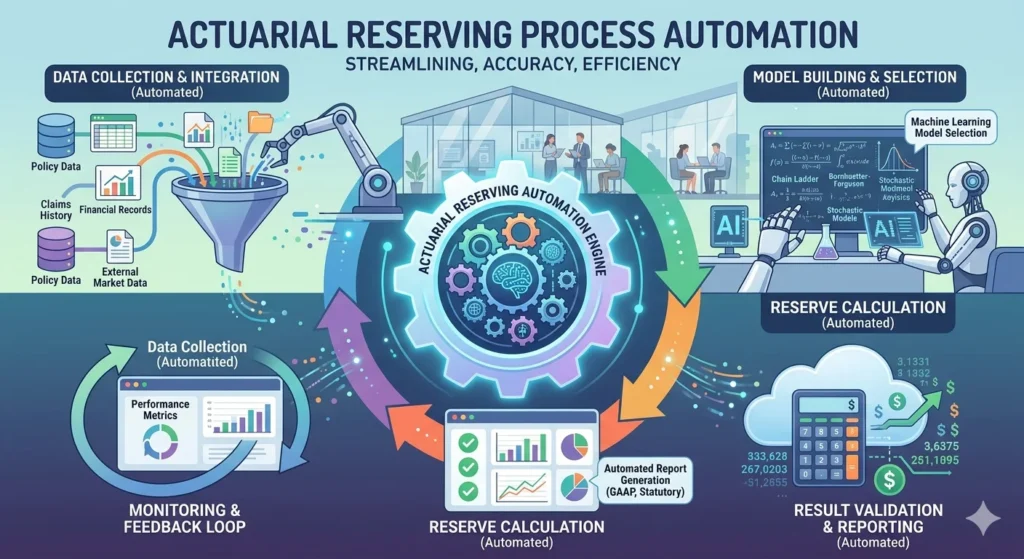
Insurance companies handle large amounts of claims data every day, and calculating reserves accurately is a critical part of their financial stability. Traditionally, this process relied on manual spreadsheets and repeated calculations, which often took a lot of time and increased the chance of errors.
Today, modern insurers are shifting toward automation to improve speed, accuracy, and consistency. The actuarial reserving process automation benefits include faster reserve calculations, reduced human error, and better use of real-time data. This helps actuarial teams move away from manual work and focus more on analysis, forecasting, and smarter decision-making.
What Is Actuarial Reserving Process Automation?
Actuarial reserving process automation uses software and modern insurance technology to automate reserve calculations, reporting, and data analysis. Instead of relying on manual spreadsheets, insurers use actuarial automation software and insurance analytics platforms to improve reserving process efficiency.
Automation can support many tasks, including:
- Reserve calculation automation
- Claims data integration
- Automated reporting
- Insurance risk assessment
- Real-time reserve monitoring
These systems help actuarial teams save time and reduce repetitive work.
How Traditional Reserving Processes Work
Traditional insurance reserving processes often depend on spreadsheets and manual data entry. Actuaries collect claims data, review historical information, and calculate reserves using different models.
This method can work, but it also creates several problems. Manual processes are slower and increase the chance of errors. When multiple spreadsheets are used across teams, it becomes harder to maintain transparent reserving methods and consistent reporting.
For example, an insurance company handling thousands of auto insurance claims may spend days updating reserve reports manually. Even a small formula mistake can affect financial results.
This is one reason many insurers are now replacing manual systems with reserve management systems and actuarial workflow automation tools.
Why Insurance Companies Are Moving Toward Automation
Insurance companies want faster reserve calculations, better claims forecasting, and improved actuarial accuracy. Automated reserving models make these goals easier to achieve.
Modern reserving software solutions can connect claims systems, financial databases, and actuarial tools into one centralized insurance data platform. This improves data-driven decision making and helps companies respond more quickly to market changes.
Automation also supports digital insurance transformation by helping insurers:
- Lower operational costs
- Reduce human error
- Improve reserve consistency
- Speed up reporting processes
- Improve actuarial team productivity
Organizations like the Society of Actuaries regularly discuss how technology and analytics are shaping the future of actuarial work.
Top Benefits of Automating Actuarial Reserving
Actuarial reserving process automation benefits go beyond simple time savings. Automation can improve accuracy, reporting, forecasting, and business performance.
Faster Calculations and Time Savings
One of the biggest benefits of automation is speed. Traditional reserving tasks can take days or even weeks when teams rely on spreadsheets.
With actuarial efficiency tools and automated reporting processes, insurers can complete reserve calculations much faster. Automated insurance forecasting systems can update data in real time, reducing delays and improving productivity.
For example, a workers’ compensation insurer may need monthly reserve updates across thousands of claims. Automation helps complete these updates quickly while reducing manual work.
Faster systems also allow actuarial teams to spend more time analyzing trends instead of entering data manually.
Better Accuracy and Fewer Human Errors
Manual processes increase the risk of mistakes. A simple spreadsheet error can create inaccurate reserve estimates and impact financial planning.
Reserve accuracy improvement is one of the strongest reasons companies invest in actuarial automation software. Automated systems use consistent formulas and advanced actuarial analytics to improve forecasting quality.
Automation also supports reserve review optimization by creating standardized workflows. This helps insurers maintain better compliance and reporting accuracy.
Improved actuarial accuracy leads to:
- Better financial planning
- More reliable reserve estimates
- Reduced reporting risks
- Improved regulatory compliance
According to the Casualty Actuarial Society, data analytics and predictive tools are becoming increasingly important in insurance reserving and risk management.
How Automation Improves Insurance Business Decisions
Automation does more than improve technical workflows. It also helps insurance companies make smarter business decisions.
Real-time reserve insights allow leaders to understand claim trends faster. Instead of waiting for monthly reports, managers can review updated information immediately.
Predictive reserving analytics also support better claims forecasting and insurance business intelligence. By studying historical claims data and market trends, insurers can identify potential risks earlier.
Automation also improves reporting for management and regulators. Automated actuarial reporting systems create faster and more accurate reports while reducing compliance risks.
This helps companies:
- Improve risk assessment
- Monitor reserve volatility management
- Support smarter reserving strategies
- Improve efficient claims management
In competitive insurance markets, faster and more accurate information can help companies respond quickly to financial changes.
Key Technologies Used in Reserving Automation
Several technologies help support modern actuarial digital transformation.
Machine Learning and Predictive Analytics
Machine learning in reserving helps insurers analyze large amounts of claims data automatically. These systems identify patterns and trends that may be difficult to detect manually.
For example, predictive reserving analytics can estimate future claims costs based on historical information. This improves automated insurance forecasting and helps insurers prepare for future risks.
Advanced actuarial analytics also support better reserve management by improving forecasting accuracy and reducing uncertainty.
Machine learning tools are especially useful for:
- Claims trend analysis
- Risk modeling
- Fraud detection
- Reserve volatility management
As technology improves, AI-powered reserving models will likely become even more common in the insurance industry.
Cloud-Based Actuarial Software and Data Integration
Many insurance companies now use cloud-based actuarial automation software because it improves flexibility and scalability.
Cloud systems allow teams to access centralized insurance data from different locations. This improves collaboration and simplifies claims data integration.
Modern insurance analytics platforms also help automate reporting, data updates, and workflow management.
Benefits of cloud-based reserving software solutions include:
- Faster system updates
- Improved data security
- Easier team collaboration
- Scalable actuarial operations
- Better reporting efficiency
These tools help insurers modernize their reserving process while reducing technology limitations.
Challenges Insurance Companies Can Reduce With Automation
Automation helps solve many common reserving challenges.
One major issue is spreadsheet dependency. Manual spreadsheets are difficult to manage and often create reporting inconsistencies.
Data silos are another common problem. When departments use separate systems, information may become outdated or incomplete. Insurance data automation helps centralize information and improve reporting consistency.
Automation also supports actuarial model governance by improving documentation and reporting transparency.
Other challenges automation can reduce include:
- Manual compliance tasks
- Slow reserve updates
- Reporting delays
- Duplicate data entry
- Inconsistent calculations
By improving streamlined reserving workflows, insurers can reduce stress on actuarial teams and improve overall operational performance.
Future of Automated Actuarial Reserving
The future of reserving automation will likely include even more AI-powered systems and advanced analytics tools.
Many insurers are already using smarter reserving strategies supported by machine learning and predictive analytics. These systems help companies improve forecasting, monitor claims trends, and make better financial decisions.
Scalable actuarial operations will also become more important as insurance companies continue handling larger amounts of data.
In the future, automated reserving systems may provide:
- Faster real-time insights
- More accurate forecasting
- Improved regulatory reporting
- Better customer service support
- Greater operational efficiency
Companies that adopt modern insurance technology early may gain a competitive advantage in the evolving insurance market.
Q&A
What are the benefits of actuarial reserving automation?
Actuarial reserving automation helps insurance companies save time, improve accuracy, and reduce manual work. It also supports faster reporting, better forecasting, and improved business decisions using real-time data and automated systems.
How does automation improve loss reserving accuracy?
Automation improves loss reserving accuracy by reducing spreadsheet mistakes and using consistent calculation methods. Automated systems also analyze large amounts of claims data quickly, helping insurers create more reliable reserve estimates.
What software is used for actuarial reserving automation?
Insurance companies use actuarial automation software, reserving software solutions, and insurance analytics platforms. Many systems also include machine learning, predictive analytics, and automated reporting features.
Can automation reduce actuarial reporting time?
Yes. Automation can reduce reporting time significantly by updating reserve calculations and generating reports automatically. This allows actuarial teams to complete tasks much faster than manual spreadsheet methods.
How does machine learning help insurance reserving?
Machine learning helps insurers analyze claims data, identify trends, and improve forecasting accuracy. It supports smarter reserving strategies and better insurance risk assessment through advanced actuarial analytics.
Why are insurance companies replacing spreadsheet-based reserving?
Spreadsheet-based reserving can be slow, difficult to manage, and more likely to contain errors. Automated systems improve reserve consistency, support compliance, and provide faster real-time insurance insights.