Many companies use software every day for work. They use tools for email, security, documents, and teamwork. But buying software for a large company can be confusing. That is why many businesses use an Enterprise License Agreement, also called an ELA.
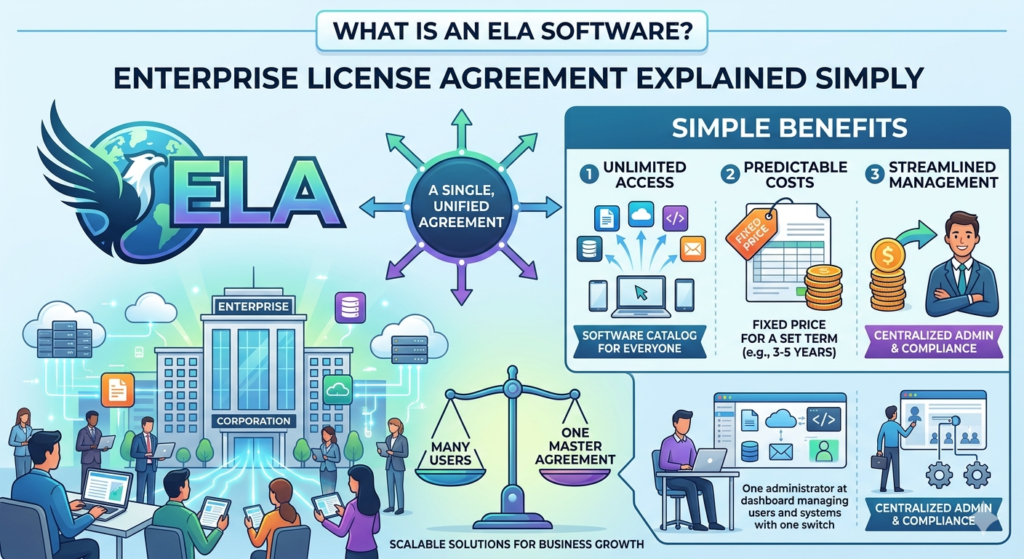
So, what is an ELA software? It is software that a company can use under one large licensing deal. Instead of buying many separate licenses, the business signs one contract with the software vendor. This agreement usually covers many users, devices, and sometimes multiple products.
An enterprise license agreement software setup helps businesses stay organized, save money, and avoid license problems. It is very common in large companies, schools, and government offices.
Basic Definition of ELA Software
ELA stands for Enterprise License Agreement. It is a contract between a vendor and an organization that explains how the company can use the software.
In a normal license, one person buys one software license. But in enterprise software licensing, a business may need hundreds of licenses. That is where an ELA helps. It gives the company a centralized software license that can be shared across teams.
ELA software definition is simple. It is a licensing method that lets an organization use software under one enterprise software contract. The agreement includes rules about usage, payment, support, and updates.
Why Companies Use ELA Software
Companies use ELAs because they make software procurement easier. Managing many licenses can take a lot of time. ELAs reduce this work.
One big reason is cost savings. Vendors often offer volume discount licensing when a company buys software in bulk. This can reduce enterprise license cost.
Another reason is predictable spending. A company can plan its budget better because it knows the price for the full contract period. This predictability of software spend is helpful for financial planning.
ELAs also help with software license management. IT teams can track licenses in one place instead of dealing with many small purchases. This reduces mistakes and improves license agreement practices.
How Enterprise License Agreements Work
An ELA starts with a negotiation between the software vendor and the company. The business chooses which products it wants. The vendor then offers pricing based on company size, usage, and contract length.
Most ELAs are multi-year licensing agreements, usually lasting three to five years. The contract terms and conditions explain what the company is allowed to do. This includes ELA deployment rules and software deployment rights.
Many ELAs include support, patches, and vendor support and updates during the contract period. Some agreements also include a true-up provision. This is a yearly check called an ELA true-up review. The company reports its usage, and the vendor confirms if the company used more licenses than expected.
That is why license usage monitoring is important. Without tracking, companies may face surprise charges.
Key Features of ELA Software
ELA software has several key features that make it useful for large organizations.
Organization-Wide Access Rights
One major benefit is organization-wide access rights. This means many employees can use the software across departments. It works like an organization-wide software license.
This is helpful for companies with large teams because they do not need to buy separate licenses for each user. It supports a multi-user software license approach.
Multi-Year Contract Terms
Most ELAs are not monthly subscriptions. They have a long contract period, often called the ELA commitment period.
This gives stability for both the vendor and the business. The agreement also includes enterprise contract renewal terms, so the company knows what happens when the contract ends.
Volume Discounts and Pricing Models
Another key feature is pricing. Many ELAs offer better pricing than buying licenses separately. This is why companies focus on the ELA pricing model during negotiation.
Some agreements offer fixed pricing, while others offer pricing based on growth. This affects enterprise software pricing and long-term cost planning.
This structure helps with license cost optimization, especially for companies that expect to expand.
License Reporting and Compliance
Many ELAs require reporting and compliance checks. Some companies use license compliance software to track usage.
This supports licensing compliance tracking and reduces enterprise licensing risks. Many organizations also use enterprise license monitoring tools to prevent overuse and stay compliant.
Common Types of Enterprise License Agreements
There are different enterprise license agreement types. Some ELAs allow unlimited software licenses during the contract period. These are sometimes called unlimited deployment agreement plans.
Other ELAs use usage-based pricing, where cost depends on users or devices. Some contracts bundle multiple tools into one enterprise software portfolio.
Many agreements also include license maintenance services, which cover updates, upgrades, and support.
ELA vs Other Licensing Agreements
It is important to understand how an ELA compares to other models.
ELA vs Traditional Per-Seat License
A per-seat license is simple. One license is for one user. This works well for small businesses.
An ELA is designed for larger organizations. It reduces the need for individual licenses and helps with license consolidation.
ELA vs Service Level Agreement (SLA)
Many people confuse ELA vs SLA license. An ELA is about licensing rights. It explains what software the company can use.
An SLA is different. It is about service quality, like support response time and system uptime. ELAs and SLAs can exist together, but they are not the same.
ELA vs Subscription Models
Subscription models are usually monthly or yearly. They are flexible, but costs may increase over time.
ELAs are usually long-term contracts. They offer better bulk pricing but less flexibility. The company must also plan for the license renewal process.
Costs and Benefits of ELA Software
The benefits of ELA software include lower costs, easier tracking, and simpler management. Many businesses see strong enterprise license benefits through discounts and reduced paperwork.
However, ELAs also have risks. If a company signs a large deal but does not use the software fully, it may waste money. That is why enterprise licensing strategy matters.
Still, ELAs are often a smart choice for large organizations with stable software needs.
How to Negotiate an Enterprise License Agreement
Negotiation is important because it affects cost and flexibility. Enterprise license negotiation should always start with research.
Assessing Software Needs Before Negotiation
Companies should review what tools they truly need. They should check usage data and remove unnecessary products. This reduces waste and improves enterprise IT procurement decisions.
Setting Terms and Pricing Goals
Companies should focus on contract terms and conditions, pricing, and deployment rules. This is where ELA negotiation tips help. A strong software vendor agreement should be clear and fair.
Planning for Growth and Renewal
A company should plan for future growth. The agreement should allow expansion without heavy penalties. Renewal terms should also be clear to avoid problems later.
Tips for Managing ELA Software Agreements
After signing, good management is required. Track usage often. Prepare early for true-ups. Keep license records organized. Review spending each year. Strong license administration processes reduce risk and improve compliance.
Simple Examples of ELA in Real Business Use
Here is a simple ELA contract example. A company with 1,000 employees needs security software. Buying separate licenses would be expensive. Instead, the company signs an ELA that covers all employees. The vendor offers discounts, and the company gets one contract.
Another example is a business that uses cloud tools, email, and storage from one vendor. Instead of separate deals, they use one ELA and manage everything in one place.
Summary: Is ELA Right for Your Organization?
ELA software is a smart option for companies that need software across many teams. It offers bulk pricing, easier tracking, and predictable costs. But it works best when a company understands its needs and manages usage carefully.
FAQ: What Is an ELA Software?
What does ELA mean in software?
ELA means Enterprise License Agreement. It is a licensing contract that allows a company to use software under one agreement instead of buying many individual licenses.
How does an ELA true-up review work?
A true-up review is a yearly check of software usage. If the company used more than agreed, it may need to pay extra. Tracking usage helps avoid surprises.
What is an IBM ELA?
An IBM ELA is an enterprise license agreement offered by IBM. It covers IBM software products under one contract and often includes discounts and support.
What is the biggest benefit of an ELA?
The biggest benefit is simplified software licensing. It reduces paperwork, improves compliance, and often lowers overall software costs for large organizations.
Is ELA better than a subscription model?
ELA can be better for large companies because it offers long-term discounts. Subscriptions are more flexible but may cost more over time.