
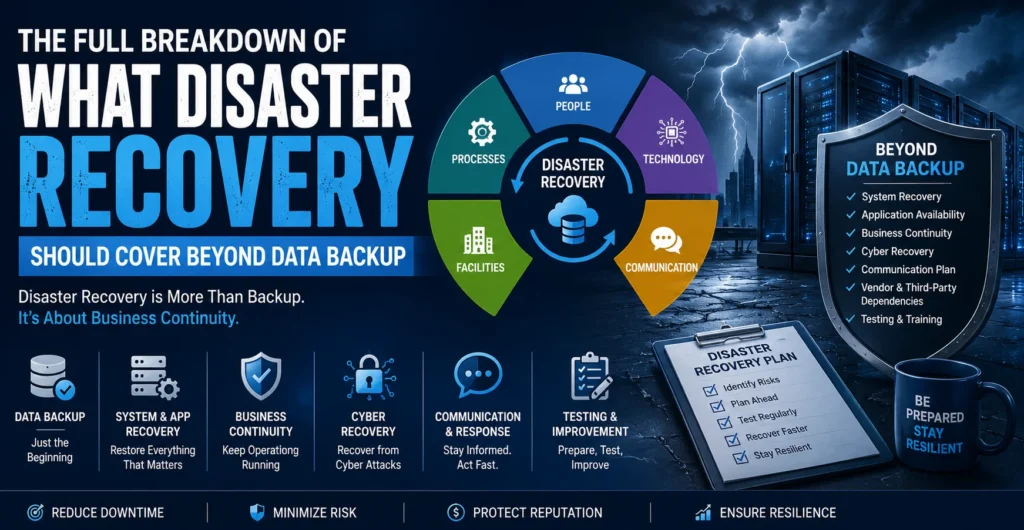
Ask most business owners whether they have a disaster recovery plan, and the answer is usually some version of “yes, we back up our data every night.” That’s a genuinely good habit, and it’s also only one piece of a much larger picture. Having a copy of your data sitting in the cloud doesn’t tell you how long it will take to actually restore operations, who’s responsible for what during an outage, or whether the recovery process has ever been tested under real conditions.
That gap between “we have backups” and “we can actually recover” is where a lot of disaster recovery plans quietly fail, usually at the worst possible moment to discover it. It’s also the gap a Charlotte IT specialist is typically brought in to close, well before the next outage puts the plan to an actual test.
The Two Numbers That Should Drive Everything Else
Before building out any recovery plan, two metrics need to be defined for every critical system: Recovery Time Objective (RTO), which is how long the business can tolerate being down, and Recovery Point Objective (RPO), which is how much data loss is acceptable, measured in time. A four-hour RTO means every part of the recovery process has to complete within that window. A one-hour RPO means backups or replication need to happen at least that often, or the business risks losing everything created since the last one.
These numbers matter because they shape every other decision: how often to back up, which systems need instant failover versus next-day restoration, and how much the whole plan should reasonably cost.
What a Complete Plan Actually Needs, Beyond the Backup Itself
A tested restoration process, not just a stored copy
Gartner research has found that a substantial share of disaster recovery plans fail to meet their RTO targets when an actual disruption occurs, and testing is consistently identified as the most commonly skipped step in disaster recovery planning. A backup that has never been restored in a test run is, functionally, an unverified assumption.
System prioritization
Not every application needs the same recovery speed. A payment processing system or client-facing platform typically needs a much faster RTO than an internal reporting tool. Without tiering systems by business impact, recovery efforts either move too slowly on what matters most or waste resources over-protecting what doesn’t.
Defined roles and communication protocols
When an outage happens, someone needs to know immediately who declares the incident, who executes the recovery steps, and who communicates with staff, clients, and vendors. A plan that lives only in one person’s head falls apart the moment that person is unavailable.
Protection against backups themselves being compromised
Ransomware increasingly targets backup systems directly, specifically because attackers know that destroying the backup removes the victim’s easiest way out. Immutable, offline, or otherwise isolated backup copies are what keep a backup from becoming just another encrypted file during an attack.
Physical and infrastructure contingencies
Data backup solves the “our systems are corrupted or encrypted” scenario. It doesn’t solve a building losing power for three days, a fiber line getting cut during nearby construction, or a facility becoming physically inaccessible after severe weather. A complete plan accounts for how the business keeps operating, not just how the data gets restored.
Where Most Plans Fall Short
| Disaster Recovery Element | Commonly in Place | Frequently Missing |
| Data backup | Usually yes | |
| Defined RTO and RPO per system | Often undefined or generic | |
| Regular restoration testing | Rarely done consistently | |
| Documented roles and communication plan | Often informal or undocumented | |
| Backup protection against ransomware | Sometimes overlooked | |
| Physical/infrastructure contingency (power, connectivity, access) | Frequently absent entirely |
The pattern across this table is consistent. Businesses tend to be reasonably good at the technical backup itself and much weaker on everything that turns that backup into an actual recovery.
Why This Matters More in a Growth Market Like Charlotte
As more companies relocate headquarters or open new offices in the Charlotte area, disaster recovery planning often gets inherited rather than rebuilt. A company moving into a new facility may bring along whatever plan worked at its old location, without accounting for different infrastructure, different regional weather risk, or a different set of critical systems that have grown since that plan was last reviewed.
This is where working with a provider that understands both the technical and regional side of recovery planning tends to matter. A plan built and tested locally accounts for the specific risks a Charlotte-based operation actually faces, rather than a generic template carried over from somewhere else.
Building a Plan Worth Trusting
The businesses with disaster recovery plans that actually hold up under pressure share a common habit: they treat the plan as something to test and revise regularly, not something to write once and file away. That means running an actual restoration test on a schedule, reviewing RTO and RPO targets as the business’s critical systems change, and confirming that roles and communication steps are documented somewhere more durable than one employee’s memory.
What Separates a Real Plan From a False Sense of Security
Data backup is the foundation of disaster recovery, not the entirety of it. A complete plan defines recovery speed and acceptable data loss for every critical system, gets tested under real conditions, protects the backups themselves from being compromised, and accounts for the physical realities of an outage, not just the technical ones. Businesses that build toward that full picture are the ones who treat a disruption as a bad day instead of a business-ending event.