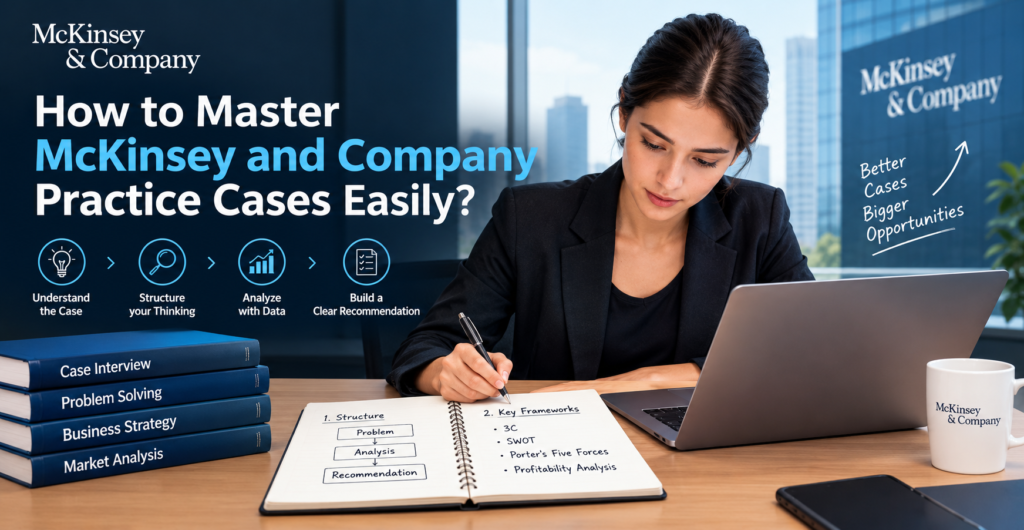
Prepping for McKinsey and Company practice cases requires a completely different strategy than preparing for other top consulting firms like BCG or Bain. While most consulting interviews follow a candidate-led format where you drive the analysis, McKinsey uses a strict interviewer-led format where the interviewer directs the flow, asks specific question types, and controls the pace.
To pass the McKinsey recruitment process, you must master three distinct hurdles: the digital assessment, the live case interview, and the personal experience interview. This guide breaks down the exact skills, frameworks, and practical strategies you need to excel at every stage.
- 📌 Decoding the McKinsey Case Interview: Structure, Format, and Expectations
- 🌳 Building Custom Issue Trees Beyond Generic Frameworks
- 📊 Mastering Quantitative Analysis, Mental Math, & Data Exhibits
- 🎮 The Pre-Screening Gateway: Preparing for the McKinsey Solve Game
- 🗣️ The Personal Experience Interview (PEI): Perfecting Behavioral Storytelling
- 💡 High-Yield Practice Execution & Solo Training Protocols
- ❓ Frequently Asked Questions (User FAQs)
📌 Decoding the McKinsey Case Interview: Structure, Format, and Expectations
The McKinsey case interview evaluates your business acumen & judgment, structured logic, and executive communication under pressure. Understanding how the case is structured helps you anticipate transitions during the interview.
🔄 Candidate-Led vs. Interviewer-Led Format: Navigating Mid-Case Shifts
In a standard candidate-led case, you determine which branch of the framework to explore next. At McKinsey, the interviewer leads the case and will actively interrupt, redirect your focus, or present unexpected case study exhibits & charts.
- Pivot Seamlessly: When the interviewer changes direction, accept the new line of inquiry immediately without clinging to your original plan.
- Maintain Structure: Apply hypothesis-driven problem solving to stay structured even when the interviewer steers the conversation toward a new topic.
🧩 The 5 Core Question Types Assessed in Every McKinsey Case
Every McKinsey case consists of five distinct question types, each evaluated separately on the partner scoring rubric:
| Question Type | Primary Focus | Scoring Criteria |
| 1. Structuring | Breaking down complex problems | Logical rigor and custom framework design |
| 2. Exhibit Interpretation | Reading charts and graphs | Identifying core trends and strategic takeaways |
| 3. Brainstorming | Generating creative ideas | Breadth, depth, and categorization of qualitative drivers |
| 4. Quantitative Analysis | Math and calculations | Speed, accuracy, and mental sanity-checking |
| 5. Synthesis | Final recommendation | Top-down structure and immediate business action |
🌳 Building Custom Issue Trees Beyond Generic Frameworks
Relying on pre-memorized frameworks like the 4Ps or Porter’s Five Forces is one of the fastest ways to fail a McKinsey interview. Partners look for bespoke problem structures tailored specifically to the client’s industry and context.
📐 Applying the MECE Principle to Bespoke Case Structures
To build a bulletproof framework, your sub-problems must follow the MECE principle (Mutually Exclusive, Collectively Exhaustive). This ensures your branches do not overlap and that all possible root causes are covered.
- 🎯 Mutually Exclusive: Every branch covers a distinct, non-overlapping area of the business challenge.
- 🎯 Collectively Exhaustive: Together, all branches account for 100% of the potential problem space.
📈 Advanced Frameworks: Deploying the Profitability Framework & Profit Tree
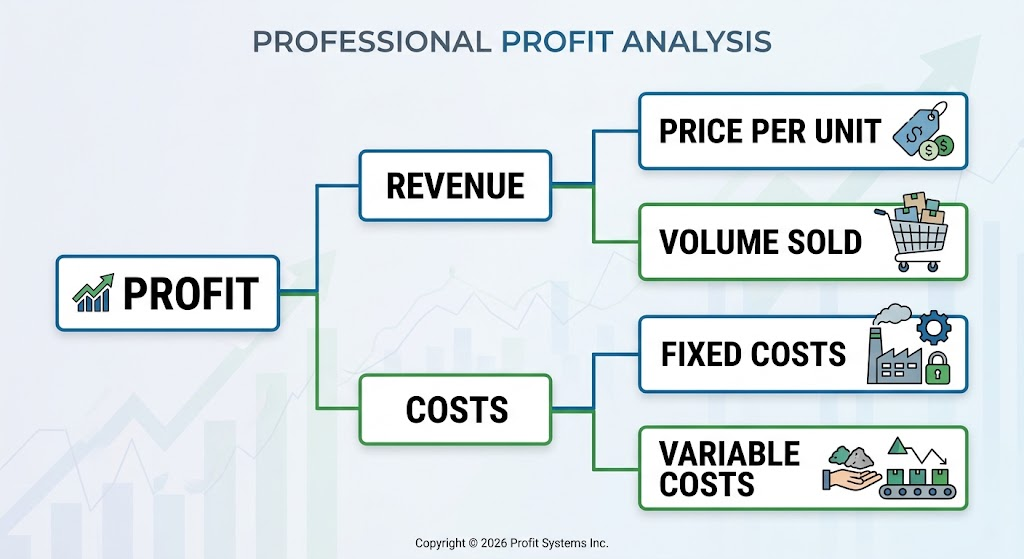
When solving a financial decline scenario, construct a customized profitability framework/profit tree to isolate revenue and cost drivers.
Beyond financial levers, always balance your hard numbers with critical qualitative drivers such as regulatory shifts, competitive responses, and internal execution risks.
📊 Mastering Quantitative Analysis, Mental Math, & Data Exhibits
McKinsey expects candidates to perform fast calculations without a calculator and immediately translate raw numbers into strategic business takeaways.
🧮 Fast-Paced Market Sizing Estimation & Math Sense-Checking
When performing a market sizing estimation, state your assumptions clearly before starting calculations. Break the population into manageable segments and use simple rounding to keep math clean.
- 👉 Sanity Check: Always run a quick “reality check” on your final output. If your calculation implies every household buys ten cars per year, pause and adjust your assumptions out loud.
💡 Moving From Numbers to Insights: The “So What?” Synthesis Framework
Never deliver a standalone number. After completing your quantitative analysis & mental math, immediately state the strategic implication for the client using the “So What?” rule.
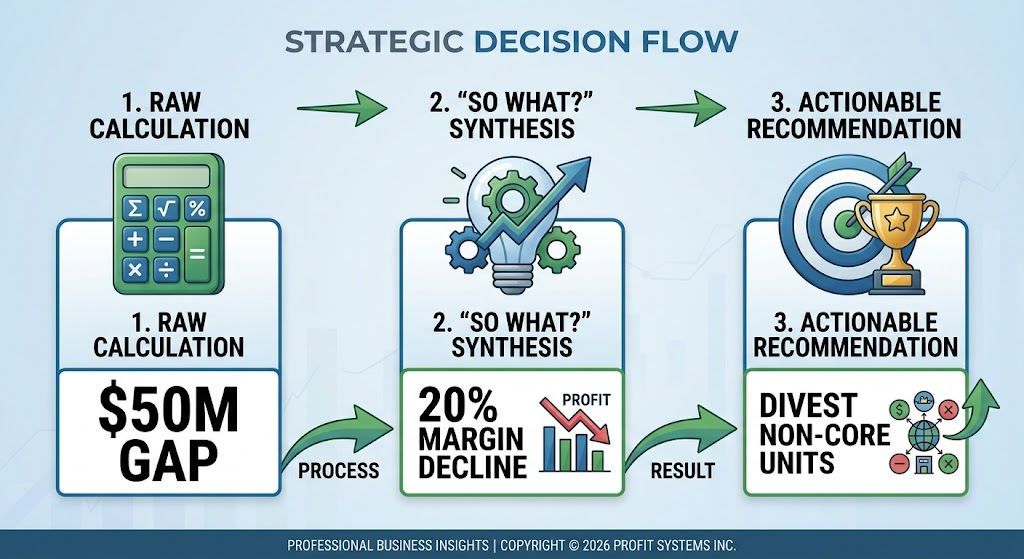
When reviewing case study exhibits & charts, state the main trend first, explain what is causing it, and conclude with actionable recommendations.
🎮 The Pre-Screening Gateway: Preparing for the McKinsey Solve Game
Before advancing to case interviews, most candidates must pass the McKinsey Solve Game (Problem-Solving Game). This digital assessment measures your raw cognitive abilities and decision-making habits in real-time scenarios.
🧠 How the Digital Assessment Predicts Case Performance
The game evaluates how you handle complex information, adapt to changing constraints, and apply business acumen & judgment in non-traditional formats like ecosystem management or red-tide strategy.
- ✅ Focus on Efficiency: Manage your time strictly, as the assessment evaluates both your decision accuracy and pace.
- ✅ Build Adaptive Habits: The structured decision-making habits you build while practicing digital scenarios directly translate into structured thinking during live case rounds.
🗣️ The Personal Experience Interview (PEI): Perfecting Behavioral Storytelling
The Personal Experience Interview (PEI) accounts for roughly 50% of your total interview score. McKinsey interviewers delve deep into a single real-life story for 15 to 20 minutes to evaluate your interpersonal leadership skills.
🌟 Aligning PEI Stories with McKinsey’s 4 Core Dimensions
Prepare 2–3 detailed stories from your academic or professional background that align with McKinsey’s four core evaluation pillars:
- 🔹 Inclusive Leadership: Guiding a team through disagreement to achieve a shared goal.
- 🔹 Entrepreneurial Drive: Overcoming significant obstacles to deliver measurable impact.
- 🔹 Personal Impact: Persuading difficult stakeholders using data and relationship-building.
- 🔹 Courageous Change: Adapting rapidly when faced with unexpected failure or disruption.
Use structured communication & synthesis (such as the PAR method: Problem, Action, Result) to keep your narrative concise, making sure 70% of your story focuses strictly on your individual actions.
💡 High-Yield Practice Execution & Solo Training Protocols
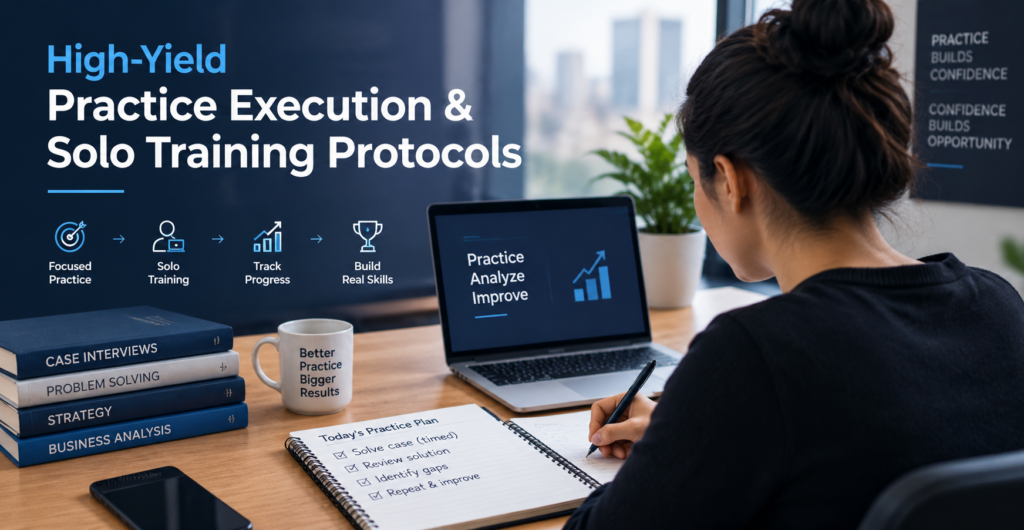
To prepare effectively, combine solo out-loud drills with live partner practice. You can review official prep resources on the McKinsey Careers Page to understand firm expectations.
⏱️ Simulating Ambiguity and Live Pressure During Solo Prep
Practicing out loud is essential for refining your structured communication & synthesis.
- 🎯 Record Yourself: Speak your framework and math synthesis out loud to identify logical gaps or hesitation.
- 🎯 Introduce Ambiguity: Practice with static cases by deliberately withholding one key metric, forcing yourself to form explicit assumptions under pressure.
These video walkthroughs demonstrate how top candidates handle real interviewer-led scenarios:
McKinsey Case Interview Example – Solved by ex-McKinsey Consultant
CASE INTERVIEW WITH FORMER MCKINSEY INTERVIEWER: FLASHFASH
YouTube · CaseCoach
McKinsey Case Interview Demo Led by Former Engagement Manager
YouTube · Management Consulted
❓ Frequently Asked Questions (User FAQs)
Are McKinsey case interviews interviewer-led?
Yes. Unlike Bain or BCG, where the candidate leads the path, McKinsey interviewers guide the case flow, ask explicit questions in sequence, and determine when to transition between structure, math, and exhibits.
Does McKinsey publish its own practice cases?
Yes. McKinsey provides official interactive practice cases on their official Careers site (e.g., Beautify, Diconsa, Electro-Light, Talbot Trucks) to help candidates familiarize themselves with the interviewer-led format.
How many interview rounds does McKinsey have?
Typically two rounds. The process usually begins with the digital assessment (McKinsey Solve), followed by Round 1 (two interviews combining PEI and cases) and Round 2 (two to three final-round interviews with Partners).
How should I prepare for the McKinsey Personal Experience Interview (PEI)?
Prepare 2–3 deeply detailed, real-life stories demonstrating Personal Impact, Entrepreneurial Drive, Inclusive Leadership, and Courageous Change. Structure your responses using top-down synthesis, focusing heavily on your specific individual actions.
How many case studies should I practice before a McKinsey interview?
Quality outweighs quantity. Most successful candidates complete 20–30 high-quality, timed live mock cases (combining solo out-loud drills and partner practice) while thoroughly debriefing every mistake.