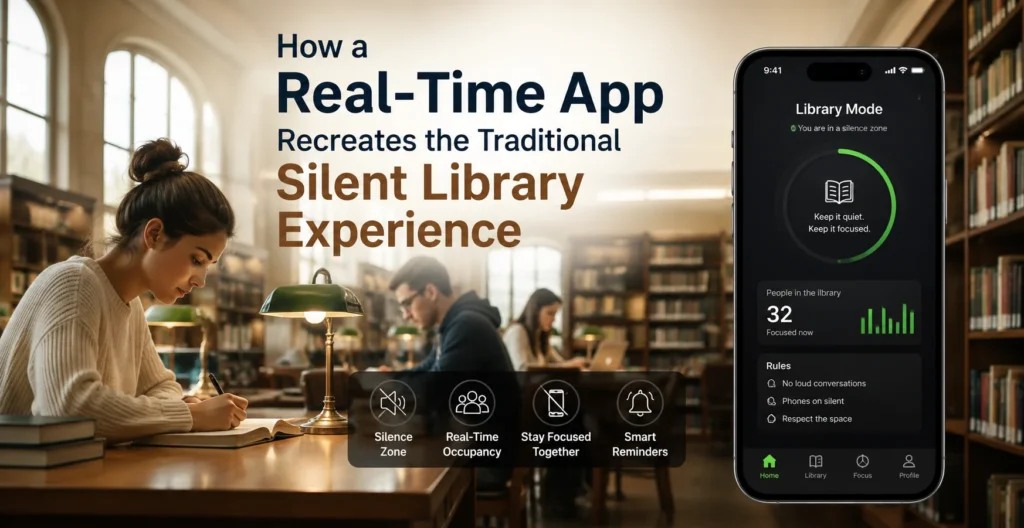
Studying at home often feels like an uphill battle. Your living space blurs the boundaries between relaxation and productivity, creating a chaotic environment for your brain. Contrast this frustrating experience with walking into a traditional library. The moment you step through the doors, the atmosphere shifts. The quiet hum of focused peers instantly signals your brain to settle down and get to work.
Why does it feel so much easier to study in these dedicated spaces? The answer lies in the profound effect our environment has on our mental state. According to a 2025 NYPL and UPenn study, 92% of patrons feel calm and peaceful after visiting a library. This data highlights exactly why isolation at home leads to anxiety and distraction, while shared study spaces naturally foster focus.
Since physical libraries aren’t always accessible, modern real-time apps are stepping in to solve this problem. These platforms use the exact same psychological principles to recreate a highly effective, distraction-free environment digitally.
The Psychological Appeal of the Traditional Library
Physical libraries offer a clear separation of space. When you commute to a library, you physically leave the distractions of your personal life behind. This environmental shift trains your brain to associate that specific building purely with deep work.
This separation drastically reduces your cognitive load. At home, your brain constantly wastes energy trying to ignore the TV, your roommates, or the laundry sitting in the corner. In a library, those triggers do not exist. Your mind is free to direct all its available energy toward the material in front of you.
However, this traditional setup comes with a major pain point. Physical libraries have restrictive opening hours, often closing their doors just as late-night study sessions begin. They get terribly overcrowded during exam seasons, turning the search for an empty desk into a stressful event. Additionally, the commute takes up valuable time that you could spend actually studying.
When deadlines loom and stress is high, students no longer need to rely on physical buildings to find focus. Technology bridges this gap beautifully. Today, you can study together online, tapping into a global virtual co-working space from anywhere in the world. This allows you to capture the psychological magic of the library without the physical limitations.
The Science of Studying Together
Human beings are naturally wired to be sensitive to social presence. The simple awareness that other people are nearby automatically alters our behavior and sharpens our focus. We subconsciously read the room and adjust our energy to match the group dynamics.
When you study in a room full of focused strangers, you experience “gentle accountability.” You feel a subtle push to stay on track, but without the anxiety of forced interaction or performance pressure. Nobody is grading your work or looking over your shoulder. They are simply existing in a productive state next to you.
This dynamic creates an ideal environment for deep work. To truly understand why studying together works so well, we need to look at two primary scientific frameworks. These psychological secrets—social facilitation and body doubling—explain exactly why shared silence stops procrastination in its tracks.
Social Facilitation and the Power of “Coaction”
What exactly is social facilitation, and how does it apply to a study environment? At its core, social facilitation is the psychological phenomenon where the presence of others naturally boosts an individual’s performance. When you know others are around, your brain enters a state of mild, productive alertness.
This concept thrives on “coaction.” Coaction is the simple act of working alongside others who are engaged in similar, independent tasks. You aren’t collaborating on a group project. You are simply doing your own work while someone else does theirs.
Social facilitation theory shows the mere presence of others engaged in similar tasks heightens attention and improves individual task performance. When you sit near a stranger who is intensely typing an essay, your brain picks up on their focused energy. This naturally prompts you to mirror their behavior and direct your attention to your own screen.
You might worry that the presence of others could cause distraction or stress. But this psychological arousal boosts productivity specifically because the shared silence removes cognitive distractions. You gain the motivating energy of a group without the disruptive noise of actual conversation.
How a Real-Time App Recreates the Traditional Silent Library Experience
Can virtual environments truly replicate the psychological benefits of a physical library? Yes, they can. Digital platforms are actively translating these psychological theories into a frictionless, highly accessible virtual ecosystem.
The core of this experience is the “Cameras On, Mics Off” methodology. This design choice perfectly mimics sitting at a shared table in a quiet university library. It eliminates all audio distractions, ensuring that no one interrupts your train of thought. At the same time, it keeps visual presence active, triggering the powerful body doubling effect on your screen.
| Feature | Physical Library | Virtual Focus Room |
|---|---|---|
| Accessibility | Limited by building hours and holidays | Open 24/7 from any time zone |
| Friction | Requires commuting, packing, and finding a seat | Instant access with a single click |
| Accountability | Physical proximity to focused peers | Visual presence via webcam grids |
| Environment | Subject to ambient disruptions and crowding | Controlled audio with a “mics off” rule |
This low-friction convenience completely solves the issue of seat shortages and early closing times. Virtual focus rooms are live around the clock, providing instant access to a productive environment whether it is 2 PM or 2 AM. You get the benefits of a bustling study hall without ever having to put on your shoes.
Beyond just a video grid, these platforms offer an all-in-one focus ecosystem. Built-in Pomodoro timers help you manage work sprints and breaks. Integrated task trackers keep your goals visible. Ambient soundscapes provide white noise to block out the sounds of your house. This complete toolset prevents the need for tab-switching, which is one of the quickest ways to break your immersion and lose focus.
Conclusion: Finding Your Focus Anywhere
You don’t need a physical library card to access the deep focus and calmness that comes from a shared study space. The digital age has made it entirely possible to bring the best parts of the library directly into your own home.
By applying psychological tools like body doubling and social facilitation, you can permanently cure chronic procrastination. The simple act of working alongside others creates the gentle, silent accountability your brain craves. It removes the burden of relying on sheer willpower and allows your environment to naturally guide your attention.