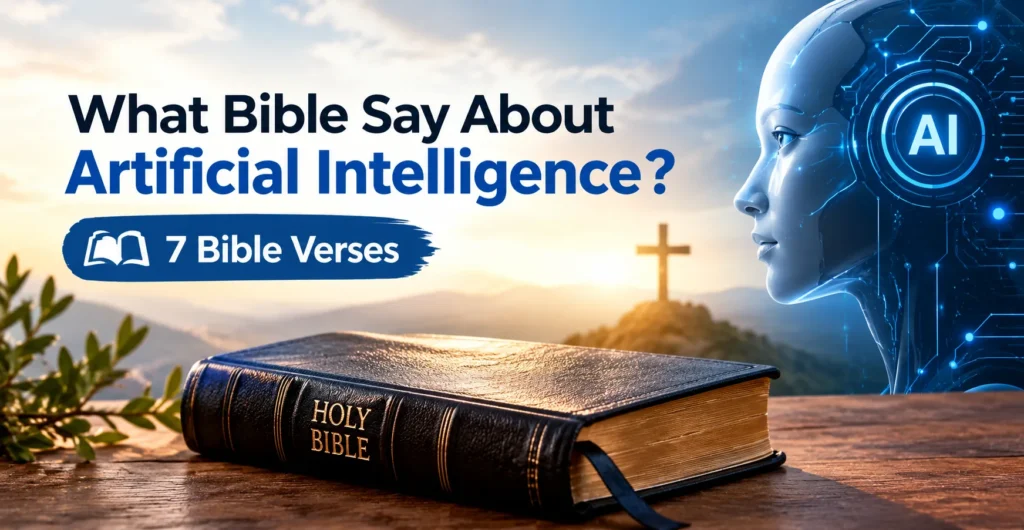
What does the Bible say about artificial intelligence? Although the Bible does not directly mention modern AI, it offers valuable guidance about wisdom, human dignity, truth, and responsible technology use. These biblical principles can help Christians understand whether using AI is acceptable and how it fits with their faith.
From Bible verses about artificial intelligence to questions like whether artificial intelligence is a sin and whether AI can have a soul, this guide explores what Scripture teaches and what remains open to interpretation. You will also learn how Christians can use AI responsibly without replacing faith, prayer, biblical wisdom, or human relationships.
- Does the Bible Mention Artificial Intelligence?
- 7 Bible Verses About Artificial Intelligence and Their Meaning
- Is Artificial Intelligence a Sin According to the Bible?
- Can AI Have a Soul or Replace Human Wisdom?
- Did the Bible Prophesy About Artificial Intelligence?
- What Would Jesus Teach Us About Artificial Intelligence?
- How Christians Can Use AI Responsibly
- Benefits and Risks of Artificial Intelligence for Christians
- Frequently Asked Questions About What the Bible Says About AI
- Final Thoughts on Artificial Intelligence and Christian Faith
Does the Bible Mention Artificial Intelligence?
Artificial intelligence is not explicitly mentioned in the Bible. The technology we know today developed thousands of years after the biblical texts were written. Still, biblical teachings can help people think through the moral questions that AI raises.
AI refers to computer systems that perform tasks such as recognizing patterns, generating text, answering questions, and creating images. These abilities can appear human-like, but producing a convincing answer is not the same as possessing human wisdom or spiritual understanding.
The relationship between Christianity and artificial intelligence depends partly on how people develop and use the technology. AI can support learning, communication, and service to others. It can also spread false information, invade privacy, or encourage people to depend too heavily on machines.
The key question is not simply whether AI exists. It is whether people use it in ways that reflect truth, love, humility, and responsibility.
7 Bible Verses About Artificial Intelligence and Their Meaning
The following passages do not directly discuss modern AI. Instead, they offer biblical principles that Christians can apply when evaluating its benefits and risks.
Genesis 1:26–27: Humans Are Made in God’s Image
Genesis 1:26–27 teaches that God created human beings in His image. Christians often understand this as the foundation of human dignity and the unique value of every person.
This teaching matters as AI becomes more capable of writing, drawing, solving problems, and communicating. A machine may perform tasks that once required human skill, but its performance does not determine a person’s worth.
The concept known as the Image of God, or Imago Dei, reminds Christians that human value is not based only on intelligence, productivity, or technical ability. People deserve respect regardless of their skills or usefulness to society.
Proverbs 3:5–6: Trust God Above Human Understanding
Proverbs 3:5–6 encourages believers to trust the Lord rather than rely entirely on their own understanding. Applied to AI, this principle warns against treating technology as an unquestionable authority.
AI can provide useful explanations, but its answers may be incomplete or wrong. Christians should not allow an AI-generated response to replace prayer, careful study of Scripture, or wise guidance from trusted people.
For example, if an AI tool recommends a particular interpretation of a Bible passage, read the passage in context and compare it with a reliable Bible translation before accepting the explanation.
Proverbs 2:6: True Wisdom Comes From the Lord
Proverbs 2:6 teaches that wisdom comes from the Lord. This provides an important distinction between artificial intelligence and biblical wisdom.
AI can process information and produce helpful suggestions. Biblical wisdom, however, involves more than knowing facts. It includes moral judgment, humility, and choosing what is right.
Christians can use AI as a research assistant, but they should still evaluate its advice through Scripture, sound reasoning, and concern for others.
Psalm 115:4–8: The Danger of Idolatry
Psalm 115:4–8 criticizes the worship of idols made by human hands. In its original context, the passage contrasts powerless idols with the living God.
The passage does not specifically condemn technology. However, it raises a useful question: Are people giving something human-made a level of trust or importance that belongs to God?
If someone begins treating AI as an unquestionable guide for every moral, personal, or spiritual decision, that dependence deserves careful examination. Technology should serve people rather than become an object of misplaced devotion.
1 Thessalonians 5:21: Test Everything Carefully
First Thessalonians 5:21 tells believers to test everything and hold on to what is good. This principle is especially useful when working with AI-generated information.
AI systems can produce incorrect Bible references, misquote passages, or present disputed interpretations as established facts. Their confident tone does not guarantee accuracy.
A practical approach is to check every quoted verse, read the surrounding passage, compare reputable translations, and consult a trusted commentary when the meaning is unclear.
Genesis 11:1–9: The Tower of Babel and Human Ambition
The story of the Tower of Babel describes people working together to build a city and a tower. The narrative focuses on their ambition and desire to make a name for themselves, followed by God’s intervention.
Some Christians compare this story with modern AI because both involve human ingenuity and the ability to accomplish tasks on a large scale. The comparison can encourage reflection on pride, power, and the purpose of technological progress.
However, the Tower of Babel is not a direct prophecy about AI. Its value here is the broader lesson that human achievements should not be separated from humility and moral responsibility.
James 1:5: Ask God for Wisdom
James 1:5 encourages those who lack wisdom to ask God for it. This principle complements the other passages by reminding Christians that difficult decisions require more than technical information.
AI may help explain the available options, but believers must still consider what is truthful, fair, compassionate, and consistent with their faith.
Is Artificial Intelligence a Sin According to the Bible?
Using artificial intelligence is not automatically a sin. The Bible does not give a direct rule about modern AI, so Christians must apply broader biblical teachings to the way they use it.
The purpose of using AI, the honesty of the activity, and its effects on other people all matter. Using AI to translate a church announcement or organize research is different from using it to deceive people, spread false religious claims, or submit someone else’s work as your own.
Christian values can guide responsible AI use in several ways:
- Honesty: Do not use AI to create fake testimonies, false evidence, or misleading religious content.
- Love and fairness: Consider whether your use of AI harms others, reinforces unfair treatment, or takes advantage of vulnerable people.
- Responsibility: Check important information instead of blaming a machine when its answer causes harm.
For example, a student may use AI to understand the background of a Bible passage. That can support learning if the student checks reliable sources and completes their own work. Copying an AI-generated assignment and falsely claiming to have written it independently raises a different ethical issue.
The same principle applies to churches, businesses, and families. The important question is whether AI is being used truthfully and responsibly.
Can AI Have a Soul or Replace Human Wisdom?
Whether AI can have a soul is a philosophical and theological question, not something that current technology can settle. The Bible teaches that human beings have a special relationship with God, but it does not directly discuss the spiritual status of modern AI systems.
Christians generally distinguish human beings from machines, although different traditions explain the soul, consciousness, and human nature in different ways. An AI system can generate a prayer, describe a religious experience, or discuss forgiveness without those abilities proving that it personally experiences faith.
It is also important to distinguish human-like communication from spiritual understanding. A machine may produce a thoughtful explanation of suffering, but a convincing response does not establish that it experiences compassion or has a relationship with God.
For this reason, AI should not be treated as a replacement for human wisdom, pastoral care, prayer, or personal relationships. It can help people explore questions, but it cannot remove their responsibility to think carefully and make moral decisions.
Did the Bible Prophesy About Artificial Intelligence?
Some Christians connect biblical passages about knowledge, powerful images, or end-times events with modern AI. These connections can be interesting to explore, but readers should separate what a passage actually says from interpretations based on current events.
Daniel 12:4 and the Increase of Knowledge
Daniel 12:4 refers to knowledge increasing in the context of a prophecy about the time of the end. Some modern readers connect this language to the rapid growth of scientific knowledge, computers, and artificial intelligence.
However, the verse does not explicitly identify AI or predict the development of a chatbot. Its meaning should be considered within the wider message and historical context of the Book of Daniel.
Technological progress alone is not proof that a specific biblical prophecy is being fulfilled.
Revelation 13:15 and the Image of the Beast
Revelation 13:15 describes an image of the beast that is given the ability to speak within the vision. Some people compare this image with AI-generated characters, robots, or realistic digital personalities.
That comparison is an interpretation, not an explicit identification in the biblical text. The passage does not name artificial intelligence, ChatGPT, or any modern computer system.
Christians may disagree about how particular prophetic passages should be understood. A careful article should explain these interpretations without declaring that AI is the Antichrist or that modern technology definitively fulfills the prophecy.
What Would Jesus Teach Us About Artificial Intelligence?
The Gospels emphasize love of neighbor, truthfulness, humility, compassion, and responsible action. Although Jesus did not discuss modern AI, these teachings offer a framework for evaluating how technology affects people.
For instance, using AI to translate information for someone who cannot read the original language may help that person access useful knowledge. Using AI to create a fake message that damages someone’s reputation conflicts with the principles of honesty and care for others.
Jesus also taught the importance of serving others rather than seeking status and power. Applied to AI, this means asking whether a tool genuinely helps people or mainly benefits those who control it.
Christians can use three practical questions to evaluate an AI tool:
- Is it truthful? Can its claims be checked against reliable evidence?
- Does it help or harm others? Consider its effects on people’s dignity, privacy, and well-being.
- Am I using it responsibly? Remain accountable for decisions instead of treating the machine as the decision-maker.
These questions do not answer every ethical problem, but they provide a useful starting point.
How Christians Can Use AI Responsibly
AI can support many activities in personal life and church communities. The goal is to use its practical abilities while preserving human judgment and spiritual responsibility.
Using AI for Bible Study and Research
AI can summarize biblical themes, explain unfamiliar terms, suggest related passages, and help organize study notes. It can also help readers prepare questions to discuss with a pastor or Bible study group.
Still, AI-generated Bible explanations need verification. A system may confuse verses, overlook context, or combine different interpretations into an answer that sounds certain.
For a practical example, suppose an AI tool explains Proverbs 3:5–6 as meaning that Christians should never use expert advice. Read the passage yourself and compare the explanation with a reputable Bible translation, such as Bible Gateway. This helps you identify whether the explanation goes beyond the text.
Using AI in Churches and Ministry
Churches may use AI to prepare administrative documents, translate announcements, create accessible materials, organize research, or develop first drafts of educational resources.
These uses can save time, but pastors and ministry leaders should review AI-generated material before sharing it. Sermons and spiritual guidance require careful interpretation, knowledge of the congregation, and human accountability.
Churches should also consider disclosing AI use when it materially affects content presented as personal testimony, original teaching, or human-created work.
Protecting Against AI Misinformation and Deception
AI-generated content can look or sound convincing while being false. Fabricated Bible quotations, fake religious images, altered videos, and invented stories about public figures can mislead readers.
Before sharing a religious claim, verify the original passage or source. Check whether a quotation appears in a trusted translation and whether a video or image has been confirmed by reliable sources.
Protect privacy, too. Avoid entering confidential pastoral conversations, private prayer requests, children’s personal information, or sensitive church records into AI tools unless appropriate safeguards and permissions are in place.
AI, Work, Creativity, and Human Worth
AI can automate some tasks and change the way people write, design, research, and work. These changes raise questions about employment, fair treatment, creative ownership, and the responsibilities of employers.
The biblical principle of human dignity offers an important reminder: a person’s worth should not be measured only by productivity or economic output. Technology should be evaluated partly by how it affects workers, families, and communities.
Christians can support useful innovation while asking whether its benefits and burdens are shared fairly.
Teaching Children and Families About AI
Parents can help children understand that AI-generated answers are not always true and that realistic images or voices may be artificially created. Children should know not to share private information with unfamiliar tools.
Families can also discuss honesty, kindness, and responsible technology use. AI should support learning and creativity without replacing personal conversation, family relationships, or trusted adult guidance.
Benefits and Risks of Artificial Intelligence for Christians
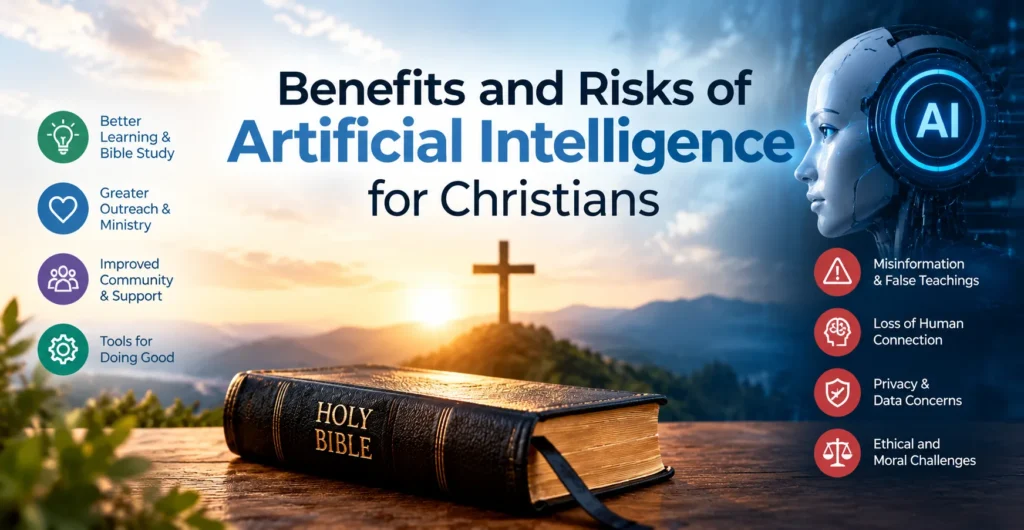
AI offers useful opportunities, but it also creates risks that deserve careful attention. Biblical wisdom and discernment can help Christians consider both sides before deciding whether a tool is appropriate.
| Potential benefits | Possible risks |
|---|---|
| Faster research and study preparation | Incorrect information and Bible references |
| Translation into different languages | Misleading or inaccurate translations |
| Better accessibility for people with disabilities | Privacy and data protection concerns |
| Support for education and creative work | Overdependence on automated answers |
| Help with church administration | Loss of human oversight and accountability |
| Faster access to information | Bias and unfair outcomes |
The benefits depend on how a tool is designed and used. For example, AI translation can help a church communicate with people who speak different languages, but important theological material should be reviewed by someone who understands both languages and the subject.
The risks also vary by application. An incorrect suggestion for organizing notes may have little impact, while inaccurate medical, legal, or spiritual advice could seriously affect someone’s decisions.
A balanced Christian approach does not require accepting every new technology or rejecting all AI tools. It requires evaluating each use according to its purpose, reliability, and effects on other people.
Frequently Asked Questions About What the Bible Says About AI
What would Jesus say about artificial intelligence?
The Bible does not record Jesus discussing modern AI. However, His teachings about love, truth, humility, and serving others provide principles for evaluating it. AI that helps people may be useful, while using it to deceive or exploit others conflicts with those values.
Did the Bible prophesy about AI?
The Bible does not explicitly name artificial intelligence or modern chatbots. Some readers connect passages in Daniel and Revelation with AI, but these are interpretations rather than direct biblical statements about the technology.
Is it okay for Christians to use AI?
Yes, Christians can use AI for appropriate purposes, such as research, translation, education, and administration. They should check its accuracy, protect private information, avoid deception, and remain responsible for how they use its output.
What does AI mean biblically?
AI means artificial intelligence, a technology that enables computer systems to perform tasks associated with human intelligence. The Bible does not define AI, but teachings about wisdom, human dignity, truth, and responsibility can guide its use.
Why was AI in the Bible destroyed?
Artificial intelligence was not destroyed in the Bible. This question may come from confusion between modern AI and the biblical story of the Tower of Babel or the image described in Revelation 13. Neither passage explicitly identifies artificial intelligence as the subject.
Final Thoughts on Artificial Intelligence and Christian Faith
The Bible does not directly address modern artificial intelligence, but it offers lasting principles for evaluating powerful tools. Passages about human dignity, wisdom, truth, humility, and responsibility can help Christians decide how to approach this technology.
AI can support Bible study, education, translation, and church work, but its answers should not be accepted without thought. It should not replace Scripture, personal faith, trusted spiritual guidance, or meaningful human relationships.
The most responsible approach is simple: use AI as a tool, verify what it tells you, protect others from harm, and remain accountable for your decisions. Technology can change quickly, but the need for wisdom and responsible action remains.