
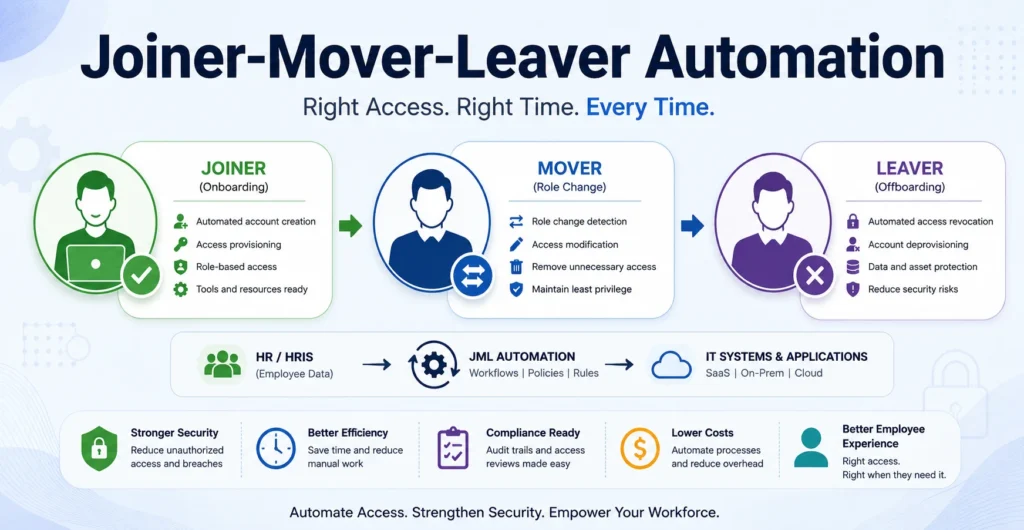
Managing employee access may sound simple, but it becomes challenging when people join, change roles, or leave an organization. Every employee needs the right tools and permissions to do their job. If access is not managed properly, businesses can face security risks, compliance issues, and unnecessary manual work.
This is where joiner-mover-leaver automation helps. By automating employee access management, companies can improve security, save time, and create a smoother experience for both employees and IT teams.
- What Is Joiner-Mover-Leaver (JML) Automation?
- How the Joiner, Mover, and Leaver Process Works
- Why Businesses Need JML Automation
- Common Challenges Without JML Automation
- Key Features of an Effective JML Automation Solution
- Security and Compliance Benefits of JML Automation
- Best Practices for Implementing JML Automation
- Choosing the Right JML Automation Platform
- Conclusion
- Frequently Asked Questions
What Is Joiner-Mover-Leaver (JML) Automation?
Joiner-Mover-Leaver (JML) automation is a process that automatically manages employee access throughout the employee lifecycle. It is an important part of identity lifecycle management and Identity and Access Management (IAM).
The three stages include:
- Joiner: A new employee joins the company.
- Mover: An employee changes roles, departments, or responsibilities.
- Leaver: An employee leaves the organization.
JML automation supports employee lifecycle management by ensuring users always have the correct access based on their role. Instead of relying on manual updates, automated workflows handle user provisioning and deprovisioning across systems.
How the Joiner, Mover, and Leaver Process Works
Joiner (Employee Onboarding)
When a new employee joins, onboarding automation helps create user accounts and assign the necessary permissions.
For example, a new marketing employee may automatically receive access to email, project management tools, and marketing software. This process is known as automated user provisioning or HR-driven provisioning.
Because access is granted automatically, employees can start working quickly without waiting for IT support.
Mover (Role or Department Changes)
Employees often change positions within a company. During these employee transitions, role change management becomes important.
For example, if an employee moves from customer service to sales, their old permissions should be removed and new permissions should be added. JML automation updates user permissions automatically, helping maintain proper access governance and reducing security risks.
Leaver (Employee Offboarding)
When employees leave, offboarding automation removes access to company systems.
Automated deprovisioning helps prevent orphan accounts, which are inactive accounts that could become security vulnerabilities. Access revocation happens immediately, reducing the risk of unauthorized access to sensitive information.
Why Businesses Need JML Automation
Organizations of all sizes benefit from workforce lifecycle automation.
First, it improves onboarding speed. New employees receive the tools they need without delays.
Second, it reduces manual IT workload. Instead of creating and removing accounts individually, automated workflows handle repetitive tasks.
Third, it strengthens security automation. Employees receive only the access they need, helping enforce the least privilege principle.
Fourth, it improves the employee experience. Workers can access the systems they need from day one.
Finally, it lowers operational costs by reducing manual processes and human errors.
Common Challenges Without JML Automation
Many organizations still rely on manual access management workflows. This often creates several problems.
Delayed account provisioning can prevent new employees from working efficiently.
Excessive access permissions may occur when employees keep access they no longer need after role changes.
Orphan accounts are another common issue. Former employees may still have active accounts if offboarding is not handled properly.
Organizations may also struggle with compliance requirements because manual processes make it difficult to track audit trails and access changes.
Human errors can further increase security risks and create gaps in user access governance.
Key Features of an Effective JML Automation Solution
A strong JML automation platform should include several important capabilities.
HRIS integration allows HR systems to communicate with identity platforms and trigger access changes automatically.
Automated provisioning and deprovisioning ensure users receive and lose access at the appropriate time.
Role-Based Access Control (RBAC) helps assign permissions based on job responsibilities. RBAC automation simplifies employee access management and improves consistency.
Approval workflows provide oversight before certain permissions are granted.
Audit logs and compliance tracking help organizations document access changes and prepare for audits.
Many modern solutions also integrate with tools such as Active Directory, Microsoft Entra ID, and Okta to streamline identity synchronization and user account management.
Security and Compliance Benefits of JML Automation
Security is one of the biggest reasons organizations adopt JML automation.
By enforcing least privilege access, employees receive only the permissions necessary for their role. This reduces opportunities for misuse or accidental exposure of sensitive data.
JML automation also supports separation of duties (SoD), which helps prevent conflicts of interest and unauthorized activities.
Continuous access governance and automated access reviews make it easier to monitor user permissions over time.
Many organizations must meet compliance standards such as SOC 2, HIPAA, and ISO 27001. Automated audit trails and access certification processes help demonstrate compliance and improve accountability.
For organizations seeking identity management best practices, the National Institute of Standards and Technology (NIST) provides valuable guidance through its Digital Identity Guidelines.
Best Practices for Implementing JML Automation
Successful implementation requires careful planning.
Start by defining access control policies and birthright access for each role. Birthright access refers to the basic permissions employees automatically receive based on their position.
Next, connect HR, IT, and identity systems so that employee status changes trigger automated actions.
Automate role-change reviews to ensure permissions remain aligned with job responsibilities.
Monitor access continuously through automated access reviews and regular reporting.
Finally, conduct periodic audits of user permissions and inactive accounts to identify potential risks and maintain compliance.
Choosing the Right JML Automation Platform
Not all solutions offer the same features.
Look for platforms with strong integration capabilities that work with existing HR systems, SaaS applications, and identity management tools.
Scalability is also important. The solution should support future growth and organizational restructuring.
Ease of deployment can reduce implementation time and training requirements.
Reporting capabilities should provide detailed audit trails, compliance tracking, and visibility into user access management.
Finally, consider the total cost of ownership, including licensing, maintenance, and administrative effort.
A platform that combines identity governance, IAM functionality, and workforce identity management can provide long-term value.
Conclusion
Joiner-mover-leaver automation helps organizations manage employee access efficiently throughout the entire employee lifecycle. By automating onboarding, role changes, and offboarding, businesses can improve security, reduce manual work, and support compliance requirements.
As organizations continue adopting cloud applications and digital workplaces, effective identity lifecycle management becomes even more important. A well-designed JML automation strategy helps ensure employees always have the right access at the right time while protecting sensitive business information.
Frequently Asked Questions
What is a Joiner Mover Leaver (JML)?
A Joiner Mover Leaver (JML) framework manages employee access during hiring, role changes, and departures. It helps organizations ensure users have the appropriate permissions throughout their employment lifecycle.
What is JML automation?
JML automation uses software to automatically grant, update, or remove user access based on employee status changes. This reduces manual work and improves security.
What is the joiner mover leaver process in IAM?
In Identity and Access Management (IAM), the JML process controls access throughout an employee’s lifecycle. New hires receive access, employees changing roles get updated permissions, and departing employees have their access removed.
Why is JML automation important for security?
JML automation reduces security risks by removing unnecessary permissions, preventing orphan accounts, and enforcing least privilege access. It helps organizations maintain stronger control over sensitive systems and data.
What are the main benefits of joiner-mover-leaver automation?
Key benefits include faster onboarding, improved employee productivity, reduced IT workload, stronger security, better compliance, and fewer manual errors.
What is the JML lifecycle?
The JML lifecycle consists of three stages: Joiner, Mover, and Leaver. These stages represent employee onboarding, role changes, and offboarding within an organization.