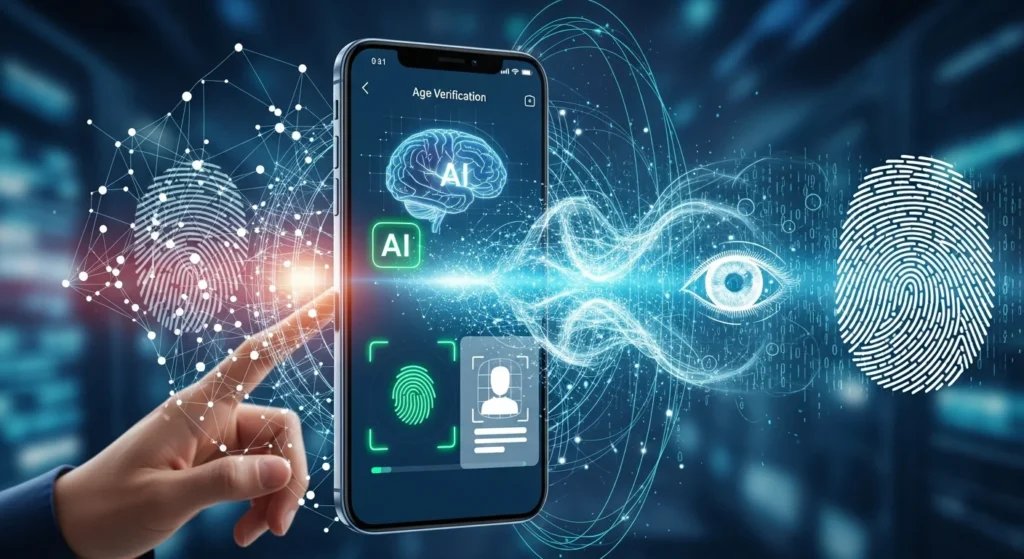
In the digital era, verifying a person’s age has become more important than ever. Online platforms that provide any financial services, medical, gaming, social media, and limited content have to make sure that users are of the required age. The traditional means, like checking documents manually, is slow, prone to errors, and can be easily compromised. This is where artificial intelligence and biometrics are changing the Digital Age Verification, and it has been faster, safer, and more reliable.
- The Growing Need for Digital Age Verification
- Understanding AI in Age Verification
- Role of Biometrics in Age Verification
- Facial Analysis and Age Verification
- Liveness Detection Prevents Fraud
- Combining AI and Biometrics for Stronger Security
- Privacy and Ethical Considerations
- Industry Use Cases of AI-Based Age Verification
- The Future of Digital Age Verification
- Conclusion
- Author’s Bio :
The Growing Need for Digital Age Verification
Digital services are expanding rapidly, and so are the risks associated with underage access and identity fraud. Laws in every corner of the globe enforce the need to safeguard minors and prevent abuse of sensitive platforms by businesses.
The main factors that lead to increased age verification are:
- Online transactions and online onboarding have increased.
- Stricter laws on data protection and child protection laws.
- Growing incidences of identity fraud and forged documents.
- The users should have quick and convenient verification processes.
The AI and biometric technologies respond to these problems by balancing robotization with human decision-making.
Understanding AI in Age Verification
The concept of artificial intelligence has been defined as systems that can analyze data, learn patterns, and make decisions with minimal human intervention. Age verification is among the uses of AI, whereby it takes a few seconds to process a lot of identity data.
How AI Improves Accuracy and Speed
The AI models are trained using millions of samples, which enable them to find subtle details that humans can not.
AI helps by:
- Audit of identity document validity.
- Background checks of counterfeit or forged IDs.
- Getting the personal information and date of birth straight.
- Reducing the human factor and errors.
This automation helps businesses to check users on-the-fly and remain compliant.
Role of Biometrics in Age Verification
Biometrics refers to the recognition through the unique physical or behavioral traits. They are difficult to imitate or steal such aspects, and this implies that they can be used in safe authentication.
Common biometric methods include:
- Facial recognition
- Fingerprint scanning
- Voice recognition
- Iris or eye pattern analysis
Biometric systems can reach a higher level of power when paired with AI as well.
Facial Analysis and Age Verification
Facial analysis is among the most common biometric tools, which are used in age verification. Algorithms of facial liveness detection approximate the age or the similarity between a live selfie and an ID photo.
How Facial Age Verification Works
AI examines:
- Skin texture and elasticity
- Bone structure and proportions of the face.
- Patterns of wrinkles and muscularity.
The system then estimates the age requirement of a user, which, in most instances, does not store even sensitive pictures.
Liveness Detection Prevents Fraud
Among the major problems of digital verification, one can mention such a phenomenon as spoofing, when users strive to defraud the systems with the assistance of photos, videos, or deepfakes. Liveness detection is an AI solution to this.
Liveness Detection Techniques
Modern systems check:
- Movements and blinking of the eyes.
- Motions of facial expression and eye.
- Light source and light homogeneity.
These checks ensure that the individual that is being verified is not a plain picture or some kind of recording.
Combining AI and Biometrics for Stronger Security
The strength is the combination of AI and biometric data. These result in a multi-layer verification procedure that is safe and easy to use.
Benefits of AI and Biometric Integration
- Instant authentication and inaccessibility.
- Better than hand checking.
- Fewer cases of identity theft and fraud.
- Solutions of global platforms that are scalable.
- Increased user compliance and trust.
Such a combination allows the companies to balance between security and convenience.
Privacy and Ethical Considerations
The problem of privacy is the crucial one, though AI and biometrics are powerful tools. Protective systems are designed in such a manner that they have the protection of data as their point of focus.
Best practices include:
- Reduction and encryption of data.
- Openness and permission with regard to the utilization of the user data.
- Compliance with international laws, such as GDPR.
- Failure to use long-term storage of biometric data.
The ethical development of AI helps in ensuring the safe usage of these technologies.
Industry Use Cases of AI-Based Age Verification
Biometric age checking and AI have already become a common practice in industries.
Common Applications
- Onboarding Financial and Banking Online.
- Special e-commerce of age-restricted products.
- Gaming and gambling services.
- Social sites and content websites.
- Medical and telemedical services.
Both apps are desirable as they have secured, fast, and compliant validation.
The Future of Digital Age Verification
Age verification will continue to improve with the improvements in AI models. The systems of the future will be less discriminatory among the demographics, become more inclusive, and less prone to the emerging dangers like deepfakes.
Expected advancements include:
- Better fairness and less discrimination.
- Improved deepfake detection.
- Contactless verification altogether.
- Simple availability throughout the online platforms.
The innovations will create a safer and more trustworthy digital space.
Conclusion
AI and biometrics are redefining digital age verification. This is the way smart data analysis, along with the peculiarities of the human being, can offer a safe, fast, and convenient solution to modern digital services. Such transformation plays a significant role in the world of amateurs as well as the professionals because age verification is turning into one of the pillars of online security and legalization in the digital age.
Author’s Bio :

Priscilla Miralles brings over 15 years of operational and project management experience to her role as the lead for Age App, where she oversees day-to-day operations and cross-team coordination. Her background at ChainIT has strengthened her expertise in managing complex workflows, optimizing processes, and supporting high-scale execution. Priscilla is known for her strong administrative leadership and ability to drive efficiency across diverse initiatives.