Artificial intelligence is helping businesses work faster, make smarter decisions, and improve customer experiences. However, as AI becomes more common, organizations need a way to understand how these systems affect business objectives, risks, and results. This is where AI business context strategic visibility becomes important.
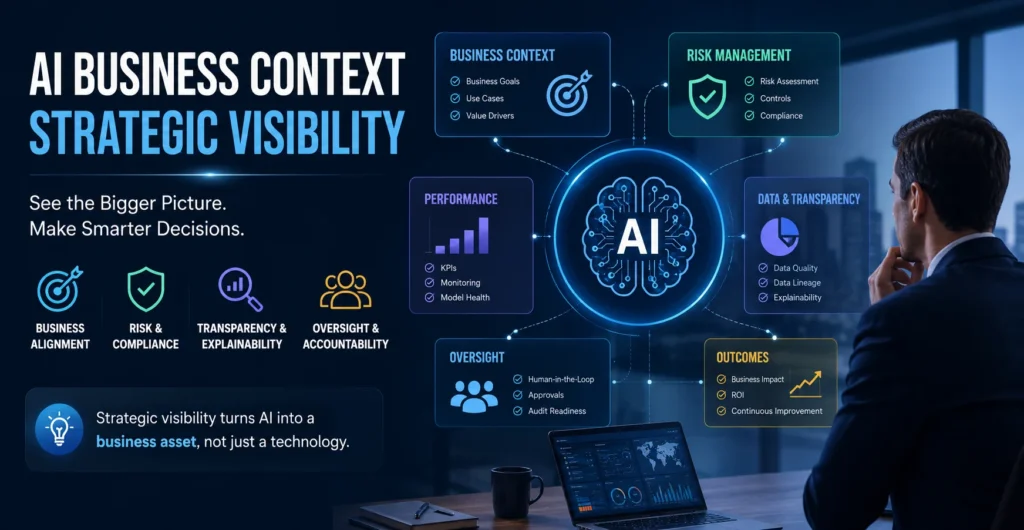
Strategic visibility gives leaders a complete view of how AI supports business goals, what risks exist, and whether AI investments are creating value. Instead of focusing only on technical performance, organizations can connect AI activities to real business outcomes.
- What Is AI Business Context Strategic Visibility?
- Why Organizations Need Strategic Visibility Into AI
- Core Pillars of AI Business Context Strategic Visibility
- How Strategic Visibility Supports the AI Lifecycle
- Common Challenges That Reduce AI Visibility
- Best Practices for Building AI Oversight and Visibility
- Benefits of AI Business Context Strategic Visibility
- Frequently Asked Questions
- Conclusion
What Is AI Business Context Strategic Visibility?
AI business context strategic visibility is the ability to see how AI systems fit into an organization’s larger strategy. It combines AI oversight, AI governance, and business alignment to help companies make informed decisions.
Many people confuse AI monitoring with strategic visibility. AI monitoring focuses on technical factors such as system uptime, accuracy, and performance metrics. Strategic visibility goes further by showing how AI affects customers, revenue, compliance, and operational success.
Business context in AI matters because automated decision systems can influence important outcomes. When leaders understand where AI is used and how it supports strategic goals, they can make better executive decision-making choices and improve organizational accountability.
Why Organizations Need Strategic Visibility Into AI
As AI adoption grows, many organizations struggle to maintain enterprise-wide visibility. Different teams may build or use AI tools without clear communication or centralized oversight.
Strategic visibility helps organizations:
- Align AI projects with business objectives.
- Improve AI accountability and transparency.
- Support board-level oversight and executive decision-making.
- Build stakeholder trust.
- Prevent disconnected AI initiatives.
Without proper AI oversight, companies may invest in projects that fail to support business priorities. Strategic visibility ensures that AI implementation strategy remains connected to measurable business outcomes.
Core Pillars of AI Business Context Strategic Visibility
Business Alignment and Decision Ownership
Every AI project should support a specific business goal. Whether the objective is improving customer service or increasing efficiency, leaders need clear decision ownership.
Business alignment helps organizations prioritize resources and measure financial ROI. It also ensures that AI strategy alignment remains connected to long-term strategic goals rather than short-term technical achievements.
Transparency, Explainability, and Data Visibility
AI transparency is essential for responsible AI practices. Organizations should understand how AI systems make decisions and what data they use.
Model explainability, often called Explainable AI (XAI), helps users understand AI recommendations. Data governance and data lineage provide visibility into where information comes from and how it moves through systems.
When organizations improve operational transparency, they create stronger trust among employees, customers, and regulators.
Risk Management and Compliance Monitoring
AI risk management is a critical part of enterprise AI governance. Organizations must identify risks before they become serious problems.
Strong AI compliance programs include:
- Risk mitigation processes
- AI auditing procedures
- Regulatory compliance monitoring
- AI risk controls
- Audit readiness reviews
These practices help businesses reduce exposure to legal, financial, and operational risks.
How Strategic Visibility Supports the AI Lifecycle
Strategic visibility is valuable throughout AI lifecycle management.
During planning and prioritization, leaders can evaluate potential projects and determine whether they support business goals. An AI inventory can help organizations track all AI initiatives across departments.
During development and deployment, governance frameworks help ensure quality, security, and compliance.
After deployment, continuous monitoring and AI performance tracking become essential. Organizations must watch for model drift, which occurs when AI accuracy decreases because conditions or data change over time.
Regular reviews of performance metrics help organizations maintain AI business value while supporting AI lifecycle governance and enterprise risk management.
Common Challenges That Reduce AI Visibility
Many organizations face obstacles when trying to improve enterprise AI visibility.
One common challenge is decentralized AI adoption. Different departments may use separate AI tools without sharing information.
Data silos also limit visibility. When information is stored in isolated systems, leaders cannot see the full picture.
Another challenge is the lack of an AI governance framework. Without clear governance policies, organizations struggle to manage AI consistently.
Poor cross-functional collaboration between technical teams and business leaders can create additional problems. Effective communication is necessary for maintaining centralized oversight and ensuring AI initiatives support organizational goals.
Best Practices for Building AI Oversight and Visibility
Organizations can strengthen AI oversight by following several proven practices.
First, create a formal AI governance framework. This framework should define responsibilities, policies, and decision-making processes.
Second, use executive AI dashboards and reporting systems. Dashboards provide leaders with visibility into performance, compliance, risks, and business outcomes.
Third, establish human oversight through a human-in-the-loop approach. Human review helps ensure AI systems remain aligned with ethical AI principles and organizational values.
Finally, track ROI, risks, and compliance continuously. Regular assessments help organizations identify issues early and improve long-term performance.
Helpful guidance on AI governance and risk management can be found through the National Institute of Standards and Technology (NIST) AI Risk Management Framework:
Benefits of AI Business Context Strategic Visibility
Organizations that invest in strategic visibility gain several advantages.
Better business outcomes occur because AI initiatives support clear objectives.
Stronger regulatory compliance reduces legal and operational risks.
Increased stakeholder trust develops when organizations demonstrate transparency and accountability.
Improved AI investment decisions help leaders allocate resources more effectively.
Sustainable competitive advantage emerges when businesses use AI responsibly while maintaining enterprise-wide visibility and governance.
Together, these benefits strengthen AI business value and support long-term success.
Frequently Asked Questions
What is AI business context strategic visibility?
AI business context strategic visibility is the ability to understand how AI systems connect to business goals, risks, and decision-making. It helps organizations manage AI more effectively while improving transparency and accountability.
Why is strategic visibility important for AI oversight?
Strategic visibility gives leaders a complete view of AI activities across the organization. This helps improve decision-making, manage risks, support compliance, and ensure AI projects align with business objectives.
What is AI in the context of business?
AI in business refers to technologies that help automate tasks, analyze information, and support decisions. Businesses use AI to improve efficiency, reduce costs, and enhance customer experiences.
What are the four pillars of AI business context strategic visibility?
The four main pillars are business alignment, transparency, risk management, and continuous monitoring. Together, they help organizations oversee AI systems and create long-term business value.
How does strategic visibility help manage AI risks?
Strategic visibility helps organizations identify compliance issues, performance problems, and operational risks early. This allows businesses to take corrective action before problems affect customers or operations.
What is model drift in AI?
Model drift occurs when an AI model becomes less accurate because data or business conditions change over time. Continuous monitoring helps organizations detect and address drift quickly.
Conclusion
AI business context strategic visibility helps organizations move beyond basic AI monitoring and connect AI systems directly to business objectives. Through strong AI governance, human oversight, transparency, and continuous monitoring, businesses can improve accountability, reduce risks, and increase AI business value.
Organizations that connect AI to business context gain better control, stronger compliance, and greater confidence in their AI investments. In today’s rapidly changing environment, strategic visibility turns AI from a technology project into a valuable business asset that supports long-term growth and success.